
What Are the SEO Services?

Your website is live, the design looks sharp, and the phone still isn’t ringing. That gap between having a site and being found is where SEO work comes in, and it’s why so many owners end up typing “what are the SEO services” into a search bar.
- SEO Services in Simple Words
- Types of SEO Services at a Glance
- Technical SEO Services: Fixing What Visitors Never See
- On-Page SEO Services: Matching the Page to the Question
- Off-Page SEO Services: Earning Trust Beyond Your Own Site
- Local SEO Services: Winning the Map and the Neighborhood
- SEO Work That Changes by Industry
- How SEO Services Work, Month by Month
- What SEO Can and Can’t Do
- How Much Do SEO Services Cost?
- How to Choose the Right SEO Service Provider
- Do You Need SEO Services? A Quick Self-Check
- Final Thoughts
- FAQs
Quick answer: SEO services are ongoing, professional work that helps search engines find, understand and trust your website, so the right people reach it when they search, without you paying for every click. The work usually covers research into what people search for, technical repairs, better pages, trust-building away from your site, and care for local listings. Agencies, freelancers and in-house specialists all provide it.
In this guide from LocalPro1, you’ll see what’s included, how the work unfolds month by month, what it tends to cost, and how to spot providers who promise more than anyone honestly can.
SEO Services in Simple Words
Think of two shops selling the same excellent product. One sits on a busy street with a clear sign. The other is down an unmarked side road. SEO services are the signs, the cleared pavement and the correct pin on the map.
It helps to separate the skill from the service. SEO as a skill is knowing how search works. SEO as a service means someone applies that knowledge to your site on a schedule, with defined tasks and reports. Most businesses are buying the second one.
Three kinds of people usually deliver it:
- Agency: a team with separate specialists for technical work, writing and outreach. It suits larger sites that need several skills at once.
- Freelance consultant: one experienced person, often with more direct contact and a lower price. It suits focused projects.
- In-house specialist: an employee who knows your products inside out. It makes sense when there’s steady work all year.
Search has also changed shape. Many people now read an AI-written summary before they click anything. Work aimed at those summaries is sometimes called answer engine optimization (AEO) or generative engine optimization (GEO). In practice it rewards what good SEO always has: clear answers, accurate facts and visible expertise. Nobody can promise that an AI tool will mention your page, so be wary of anyone who does.
Types of SEO Services at a Glance
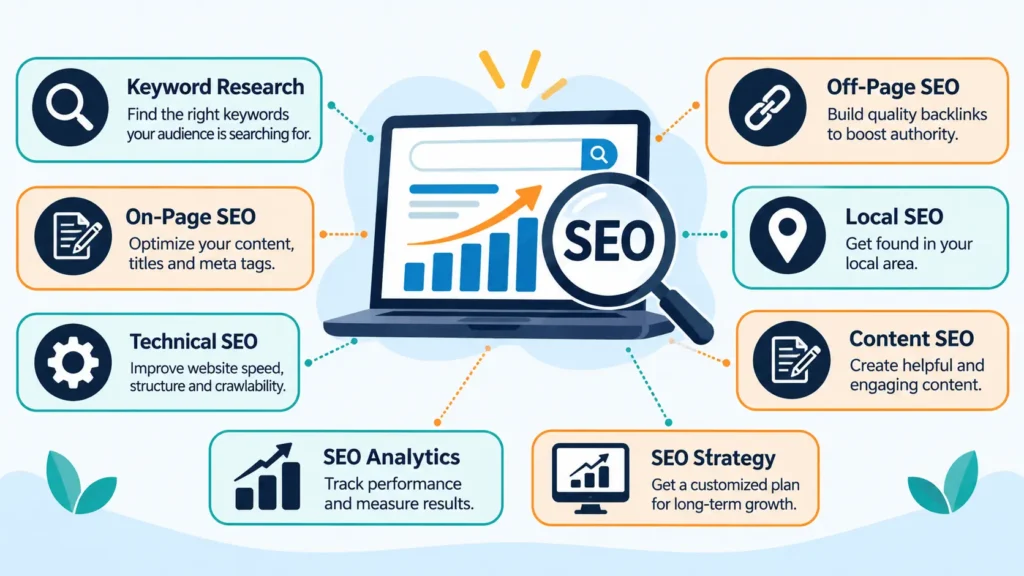
So, what are the SEO services you’ll actually see on a proposal? The types of SEO services below cover most of what providers offer:
- Audit and strategy: a health check of your site and your competitors, turned into a priority list. Without it, everything else is guesswork.
- Keyword and intent research: finding the words customers use and what they expect to see. Someone searching “boiler repair near me” wants a different page from someone searching “how does a boiler work”.
- Technical SEO services: fixes that let search engines reach and read your pages quickly.
- On-page SEO services: improvements to titles, headings, copy and internal links so each page answers a clear question.
- Content creation and updates: new pages for gaps, and refreshes for pages that have gone stale.
- Off-page SEO services: earning links, mentions and reviews from other places on the web.
- Local SEO services: work that helps you appear for nearby searches and in map results.
- Reporting and refinement: regular updates on what changed, what worked and what comes next.
The next four sections go deeper into the ones that cause the most confusion.
Technical SEO Services: Fixing What Visitors Never See
Technical SEO services make sure search engines can crawl your pages, understand them and store them, and that people don’t leave while a page loads. Because the problems are invisible, they often go unnoticed for months.
A few real-world patterns show up again and again:
- Pages blocked by accident. After a redesign, a “do not index” setting meant for the test copy sometimes travels to the live site. Pages then fade out of search without any warning. A technical review can catch this within a day.
- Duplicate addresses. An online store with filters for size, color and price can generate thousands of near-identical URLs. Clear rules and canonical tags point search engines toward the pages that matter.
- Heavy images. Uncompressed photos are one of the most common reasons a mobile page feels slow.
- Structured data. Labels in the page code tell machines whether a page describes a product, an article or a local business. They help with interpretation, but they don’t guarantee any special display.
One practical tip: ask for a fix list that says who handles each item. Many technical changes need developer time, and a report that nobody acts on is wasted money.
On-Page SEO Services: Matching the Page to the Question
On-page SEO services focus on what sits on each page: the title, headings, copy, images and internal links. The aim isn’t to sprinkle keywords around. It’s to answer the question that brought the visitor there in the first place.
Here’s what that looks like in practice:
- Lead with the answer. A short, direct answer near the top, followed by the detail, helps readers and makes the page easier for answer tools to quote.
- Merge competing pages. If three old blog posts chase the same phrase, combining them into one strong page often works better than keeping all three.
- Use honest titles. Keep them specific, readable and roughly under 60 characters, with no clickbait.
- Link with purpose. Descriptive anchor text such as “emergency boiler repair” tells people and search engines what waits on the other side.
- Show proof. Author names, real photos, dates and sources make a page easier to trust.
Picture a software company whose support articles answer questions better than its sales pages. A sensible on-page project would move those clear answers into the pages buyers actually land on.
Off-Page SEO Services: Earning Trust Beyond Your Own Site
Off-page SEO services cover signals that come from outside your website: links from other sites, mentions, reviews, and general reputation. Quality matters far more than quantity. One relevant link from a respected trade publication usually says more than hundreds from sites that exist only to sell links.
Healthy tactics include publishing original guides or data that others want to cite, offering expert comments to journalists, partnering with local associations, and asking real customers for reviews after a job.
Risky tactics include buying links, large-scale link swaps, and networks of throwaway sites. Google’s spam policies name link schemes directly. Its September 2026 spam update ran from 24 September to 8 October, and Google didn’t spell out exactly what it targeted. The safest approach is to stay inside the published rules.
Local SEO Services: Winning the Map and the Neighborhood
Local SEO services help a business appear when someone searches nearby, both in the map results and in the regular listings. The core work includes:
- completing and maintaining the Google Business Profile, with accurate categories, services, hours and photos
- keeping your name, address and phone number consistent across directories
- collecting reviews and replying to them
- building location pages that describe a real service area, not the same text with the city name swapped
Take a neighborhood bakery that wants to show up for “custom birthday cakes near me”. The useful steps are photos of real cakes, correct holiday hours, reviews that mention cake types, and a page explaining how much notice an order needs. None of it involves tricks.
If you serve a busy metro market, a dedicated page for SEO Services in New York shows how location-focused work can be scoped.
SEO Work That Changes by Industry
The types of SEO services you need depend heavily on what you sell and how people buy it.
- Ecommerce: category structure, product page copy, handling out-of-stock items and avoiding duplicate filter pages.
- Software and B2B: help guides, comparison pages and long sales cycles. Measure demo requests, not just visits.
- Local service businesses such as clinics, repair trades and law firms: location pages, trust signals and call tracking.
- Enterprise and international sites: language and region tags, shared rules for many editors, and careful site migrations.
How SEO Services Work, Month by Month
SEO is a sequence, not a switch. A realistic plan looks like this:
- Month 1: audit, goals and tracking setup. Decide what counts as a lead before touching the site.
- Months 2 to 3: technical fixes, updates to priority pages and a content plan.
- Months 4 to 6: new content, outreach, local profile growth and testing.
- After six months: maintenance, new topics and refreshing older pages.
Be patient. Recovery after a core update commonly takes three to six months, and Google began its November 2026 core update on 10 November. Early movement is worth noticing, but it isn’t proof of anything yet. You can follow official rollouts on the Google Search Status Dashboard.
What you should receive each month:
- A plain list of the work completed
- Calls, form fills or sales that came from search
- Traffic to your key pages, focused on qualified visitors
- Rankings for priority terms, with context
- Problems found and the plan for next month
What SEO Can and Can’t Do
SEO can bring steady discovery from people who are already looking, reduce your dependence on paid ads, make your site faster and clearer, and build credibility over time.
It can’t guarantee rankings. Google says plainly that no one can promise a top spot, which you can read in its guidance on hiring an SEO. It also can’t work overnight, fix an offer nobody wants, or make up for slow follow-up on the leads it brings in.
How Much Do SEO Services Cost?
Prices vary with industry, competition and location, so treat any number as a starting point. One commonly quoted range for agencies is roughly $2,500 to $5,000 a month, and freelancers often charge around $100 to $300 an hour. Small local scopes can cost less, and enterprise work costs more.
| Pricing model | Best for | Typical range |
| Monthly retainer | Ongoing growth and steady content | Commonly a few thousand dollars a month |
| Hourly | Advice, reviews and training | Often $100 to $300 per hour |
| Project-based | Audits, migrations and one-time fixes | Depends on scope, so ask for an itemized quote |
What moves the price: site size, how crowded your market is, how much content you need, how much outreach is involved and how ambitious your goals are.
Cheap isn’t always bad. A small, well-scoped plan from an honest freelancer can work very well. But an unusually low price paired with big promises is a warning sign.
How to Choose the Right SEO Service Provider
A good provider explains the plan before asking for a contract. If you already have a proposal and want a second opinion, LocalPro1 is a useful place to ask questions before you sign.
Questions worth asking
- What will you do in the first 90 days, and why in that order?
- Who actually does the work, and who will I speak to?
- What will your monthly report include?
- Can you show past work that is relevant to my industry?
- How do you avoid tactics that could put my site at risk?
Red flags
- Guaranteed number one rankings
- Mass-produced AI content with no human review
- Bulk or paid links, or link networks
- Tricks aimed at manipulating AI answers, which Google has said counts as spam
- No access to your own accounts or data
- Vague reports that list activity but never results
What good SEO looks like after recent spam and core updates is fairly simple: useful content written by people who know the topic, clear authorship, original insights, a clean site, links earned naturally and claims you can verify.
Do You Need SEO Services? A Quick Self-Check
Ask yourself these questions:
- Is your traffic flat while competitors keep climbing?
- Do customers say they couldn’t find you online?
- Is your site slow, hard to use on a phone, or partly missing from search?
- Do you depend only on paid ads for leads?
- Do you serve a local area but barely appear on the map?
If you answered yes to two or more, an audit is a sensible next step. If your budget is tight, you can start in-house: claim and complete your business profile, fix slow pages and improve your main service pages. Bring in help when the work needs skills or hours you don’t have.
Final Thoughts
So, if you came here asking what are the SEO services worth paying for, the short version is this: a mix of technical fixes, better pages, earned trust and local profile care, delivered on a schedule you can measure. The honest takeaway is that SEO rewards patience and punishes shortcuts, especially after this year’s spam and core updates. Start with an audit and one clear goal, then build from there.
When you’re ready to talk it through, contact us at LocalPro1, or take a look at how we approach SEO Services in New York.
FAQs
How long do SEO services take to show results?
Most businesses see early movement within a few months, but meaningful gains usually take around six months or longer, depending on competition and the condition of the site. Technical SEO services can speed things up when a site has serious problems, though search engines still need time to re-crawl and reassess pages.
Are SEO services worth it for small businesses?
They can be, especially when customers search for what you sell in your area. Local SEO services are often the most cost-effective starting point because the competition is narrower and the intent is strong. Set a clear goal, such as calls per month, so you can judge the value.
What is the difference between SEO and paid ads?
Paid ads bring visitors only while you keep paying, and they work quickly. SEO takes longer to build, but the pages you improve can keep attracting visitors without a charge per click. Many businesses use both: ads for quick tests and SEO for lasting groundwork.
Can SEO services guarantee first-page rankings?
No. Search engines decide rankings, and Google itself says no one can promise a top spot. Treat any guarantee as a warning sign and ask for a clear plan and honest reporting instead.
Do SEO services help with AI search results?
They can support them, because AI summaries tend to draw on clear, well-structured, trustworthy pages. Good on-page SEO services, accurate facts and visible expertise improve the chance of being understood, but no one can guarantee a citation.
Ready to Grow Your Business Online?
Get a custom strategy built around your goals. Our team will review your current marketing and show you exactly where the growth opportunities are.
- Free 30-minute strategy call
- Custom growth roadmap
- No obligation or hidden fees