
What Is a Content Pillar?

If you have ever tried to plan a month of blog posts and ended up staring at a blank document with no idea what to write next, you already understand the problem content pillars solve. A content pillar is a broad, authority level topic that acts as the anchor for a group of smaller, related articles on your website. Instead of publishing random posts and hoping something ranks, you build a structure that search engines and readers can both follow.
- What Is a Content Pillar? (The Full Definition)
- What Are Content Pillars vs. Content Clusters vs. Pillar Pages
- Why Content Pillars Are Important
- Types of Content Pillars
- How Many Content Pillars Do You Actually Need
- How to Build a Pillar Content Strategy Step by Step
- Content Pillar Examples From Real Industries
- Common Mistakes to Avoid When Choosing Content Pillars
- How to Measure the Success of Your Content Pillars
- Content Pillars vs. Traditional Blog Topics
- Final Thoughts
- Frequently Asked Questions
Quick takeaway: A content pillar is the main topic your website is known for, and every smaller article you write connects back to it, which is exactly why this concept sits at the center of any serious SEO plan. At LocalPro1, this is one of the first things we set up before writing a single blog post for a client, because it changes how a website performs months later, not just how it reads today.
What Is a Content Pillar? (The Full Definition)
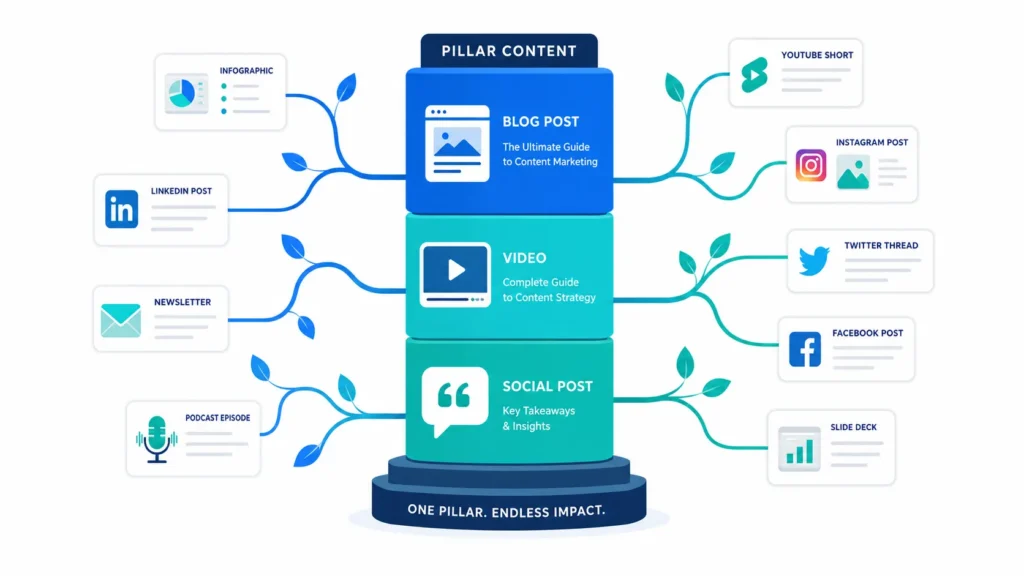
So, what is a content pillar in practical terms? Picture your website as a house. The pillar is the load bearing wall, the strong central topic that holds everything up. The smaller blog posts, guides, and FAQs are the rooms built around that wall, and they all connect back to it through internal links.
A simple analogy makes this easier to remember. If your business is a bakery, your pillar might be “Wedding Cake Guide.” Around that pillar you would build smaller pieces like “How to Choose a Cake Flavor,” “Wedding Cake Pricing Explained,” and “Cake Delivery Tips for Outdoor Venues.” None of those smaller posts could carry the same authority alone, but together, linked back to the pillar, they tell Google and your readers that you genuinely know this subject.
This is different from a regular blog post in one key way: a blog post usually answers one narrow question, while a pillar covers an entire topic broadly enough that it can host dozens of related articles underneath it without running out of room.
What Are Content Pillars vs. Content Clusters vs. Pillar Pages
People mix up these three terms constantly, and honestly, most articles online do not explain the difference clearly. Here is a straightforward breakdown.
| Term | What It Actually Is |
| Content Pillar | The broad theme or subject your content strategy is built around |
| Content Cluster | The group of smaller, related articles that support the pillar |
| Pillar Page | The actual webpage where the pillar topic lives, usually a long, detailed resource |
So when someone asks what are content pillars, the short answer is: they are the themes. The pillar page is where that theme gets published, and the cluster is everything that links to it. Confusing these terms is common, but understanding the difference is what separates a real pillar content strategy from a pile of unrelated blog posts.
Why Content Pillars Are Important
They Build Topical Authority
Search engines reward websites that demonstrate depth on a subject, not just breadth. When you publish ten interconnected articles about commercial roof repair instead of one lonely post, Google starts to trust that your site actually knows the topic.
They Create a Natural Internal Linking Structure
Every cluster article links back to the pillar, and the pillar links out to the clusters. This gives search engine crawlers a clear map of your site and helps pages that might otherwise get buried actually get discovered and indexed.
They Keep Your Messaging Consistent
Without a plan, content teams tend to drift. One month it is about pricing, the next it is a random trend piece that has nothing to do with the business. Pillars keep everyone writing toward the same core themes, which matters even more now that Google’s helpful content systems are actively down ranking sites that publish scattered, low value pages.
They Simplify Content Planning
Instead of asking “what should we write about this week,” your team asks “which cluster article does our roofing pillar still need.” That single shift removes most of the guesswork from a content calendar. This is part of why our team at LocalPro1 always starts strategy sessions by mapping out pillars first, long before any writing begins.
They Improve User Experience and Time on Site
When a reader finishes one article and finds three more relevant ones linked right there, they stay longer, trust you more, and are more likely to convert.
Types of Content Pillars
Not every pillar looks the same, and picking the right type depends on your goals.
Educational pillars teach the audience something, like “Beginner’s Guide to HVAC Maintenance.” These build trust slowly but effectively.
Promotional pillars are built around your services or products, positioned to move readers closer to a purchase decision without feeling like a sales pitch.
Engagement pillars invite interaction, comments, or community participation, and work especially well for brands with active social channels.
Brand values pillars focus on your story, mission, or what makes your business different from the next one down the street.
“What Is” or explainer pillars, like this very article, define a topic clearly for people typing questions straight into a search bar, which is often the first touchpoint a new visitor has with your brand.
How Many Content Pillars Do You Actually Need
Most established brands run somewhere between three and five pillars. Fewer than three usually means you are not covering enough ground to build real authority, while more than five tends to spread your content team too thin and dilute your focus.
A small local business might only need two or three pillars tied directly to its core services. A larger company with multiple product lines might justify five or six, but even then, each one needs its own dedicated cluster of supporting content to actually work. The number should match what your team can realistically sustain long term, not just what looks impressive on paper.
How to Build a Pillar Content Strategy Step by Step
Step 1: Understand What Your Audience Actually Searches For
Before choosing a pillar, look at the real questions your customers ask, whether that is through customer service tickets, sales calls, or keyword research tools.
Step 2: Match Pillars to Your Business Expertise
A pillar only works long term if you can genuinely speak to it. Choosing a topic you cannot back up with real experience is one of the fastest ways to lose reader trust.
Step 3: Research Keywords Around the Topic
Look for one broad “head” keyword for the pillar page itself, and a handful of longer, more specific keywords for the cluster articles underneath it.
Step 4: Choose and Commit to Your Pillar Topics
Write them down, assign each one an owner, and treat them as fixed points your content calendar revolves around for the next several months.
Step 5: Plan the Supporting Cluster Content
List out five to ten smaller article ideas per pillar. These should each answer one specific question that a reader with buying intent might type into a search engine.
Step 6: Build the Internal Linking Structure
Link every cluster article back to its pillar page, and update the pillar page to link out to new cluster content as it gets published. If you want this done properly and connected to a broader SEO plan, our team offers Professional SEO Services in NY that handles this exact structure for clients from research through execution.
Content Pillar Examples From Real Industries
SaaS business: A project management software company might build a pillar around “Remote Team Collaboration,” with clusters covering async communication tools, meeting fatigue, and time zone scheduling.
Local service business: A plumbing company could build a pillar titled “Home Water Pressure Problems,” supported by cluster posts on pipe corrosion, well pump troubleshooting, and seasonal maintenance checklists.
E-commerce brand: A skincare shop might anchor a pillar on “Building a Skincare Routine for Sensitive Skin,” with clusters on ingredient guides, patch testing, and seasonal product swaps.
Personal brand or creator: A freelance photographer could center a pillar on “Getting Started in Wedding Photography,” with clusters on gear recommendations, pricing packages, and client contracts.
Common Mistakes to Avoid When Choosing Content Pillars
One frequent mistake is picking a pillar that is too broad, like “Marketing,” which is nearly impossible to fully own. The opposite problem, picking something too narrow, like “Blue Widget Sizing,” leaves no room for cluster content to grow.
Another mistake is choosing pillars based on what sounds impressive rather than what your actual audience is searching for. Some businesses also pick pillars that have nothing to do with what they genuinely offer, which tends to confuse both readers and search engines about what the site actually does. Finally, many teams set pillars once and never revisit them, even as their business, audience, or industry shifts over time.
How to Measure the Success of Your Content Pillars
Track organic traffic specifically to your pillar page and its connected cluster articles over time, not just site wide numbers. Watch keyword rankings for both the head term and the long tail terms tied to each cluster piece.
Engagement metrics matter too. If people land on a cluster article and immediately leave, something in the content or the internal linking is not working. Finally, track conversions that originate from pillar traffic specifically, since this tells you whether the strategy is actually driving business results, not just page views.
Content Pillars vs. Traditional Blog Topics
A traditional blog post usually stands alone, answering one question and moving on. A pillar content strategy, by contrast, treats every piece of content as part of a bigger structure, where each article strengthens the ones around it instead of existing in isolation.
Final Thoughts
At this point, the concept should feel far less abstract. A content pillar is simply the anchor topic that holds your content strategy together, and once you build the clusters around it, your website starts working as a connected system instead of a scattered collection of posts.
If you are ready to turn this into an actual pillar content strategy for your business but are not sure where to start, the LocalPro1 team can map out your pillars, plan the supporting content, and handle the technical execution from start to finish. Contact us today and we will walk you through exactly what that looks like for your website.
Frequently Asked Questions
Are content pillars only useful for social media?
No, content pillars apply to websites, blogs, and SEO strategy just as much as social media. In fact, a pillar content strategy for a website often has a bigger long term impact on organic traffic than social posting alone.
How often should I update my content pillars?
Most businesses review their pillars once or twice a year, or whenever their services, audience, or industry shifts significantly. Outdated pillars can quietly hurt rankings if the cluster content around them stops matching what people are actually searching for.
Can a small business realistically manage more than one content pillar?
Yes, but it depends on your team’s capacity. Two or three well maintained pillars will always outperform five neglected ones, especially when trying to explain what are content pillars in a way that customers actually find useful.
What’s the real difference between a pillar page and a landing page?
A pillar page is educational and designed to inform, while a landing page is built specifically to convert a visitor into a lead or sale. They can work together, but they serve very different purposes in a funnel.
Do content pillars actually help with Google rankings?
Yes, because they build topical depth and a clear internal linking structure, both of which search engines use to judge authority. This is exactly why understanding what is a content pillar matters if you are serious about long term organic growth.
Ready to Grow Your Business Online?
Get a custom strategy built around your goals. Our team will review your current marketing and show you exactly where the growth opportunities are.
- Free 30-minute strategy call
- Custom growth roadmap
- No obligation or hidden fees