
What Is White Hat and Black Hat SEO? A Clear Guide for 2026
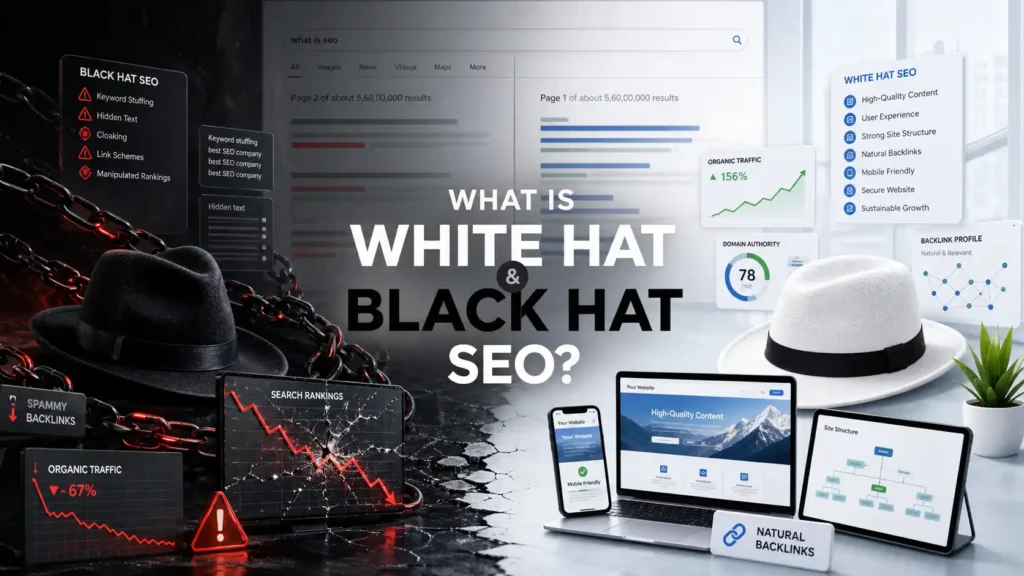
A single ranking update can double a site’s traffic or wipe most of it out. The gap usually comes down to the methods behind the site, not the size of the budget. So, what is white hat and black hat SEO? White hat SEO earns rankings by helping searchers and following Google’s rules. Black hat SEO tries to manufacture rankings by fooling search systems.
- Where Do the Terms “White Hat” and “Black Hat” Come From?
- What Is White Hat SEO?
- What Is Black Hat SEO?
- What Is Gray Hat SEO?
- White Hat vs. Black Hat vs. Gray Hat Comparison
- The Hat Test: Score Any SEO Tactic in 60 Seconds
- Real Consequences of Black Hat SEO
- Google’s 2026 Spam Updates: What We Actually Know
- How to Check Whether Your Site Has Been Hit
- How to Recover From a Spam Penalty
- White Hat SEO Best Practices Checklist
- Red Flags When Hiring an SEO Provider
- Final Thoughts
- Frequently Asked Questions
Knowing the difference between white hat and black hat SEO matters more this year, because Google has confirmed four spam updates in 2026. At LocalPro1, we build strategies around long-term trust, and this guide shows you how to judge any tactic yourself before it puts your site at risk.
Where Do the Terms “White Hat” and “Black Hat” Come From?
The labels come from old Western films, where heroes wore white hats and villains wore black ones. Early search marketers borrowed the shorthand to separate honest optimization from manipulation.
The colors describe intent, not technology. A tactic is white hat when it helps visitors and stays within Google’s guidelines. It is black hat when its main purpose is to trick ranking systems.
What Is White Hat SEO?
White hat SEO is the practice of improving a site’s visibility with methods that follow search guidelines and put the searcher first.
The most reliable white hat SEO techniques include:
- Matching each page to one clear search intent
- Publishing original information that real experience makes possible
- Fixing slow pages, broken links and crawl errors
- Earning links because the content deserves them
- Writing honest titles and descriptions that match the page
Picture a plumbing company that publishes a page on what burst pipe repairs typically involve in its own service area, using its real job photos and price ranges from its own work. No competitor can copy that page, because the information belongs to the business. That is the core of white hat work: content that only you can publish.
These white hat SEO techniques take months to show results. The trade-off is that they keep working after algorithm changes instead of collapsing.
What Is Black Hat SEO?
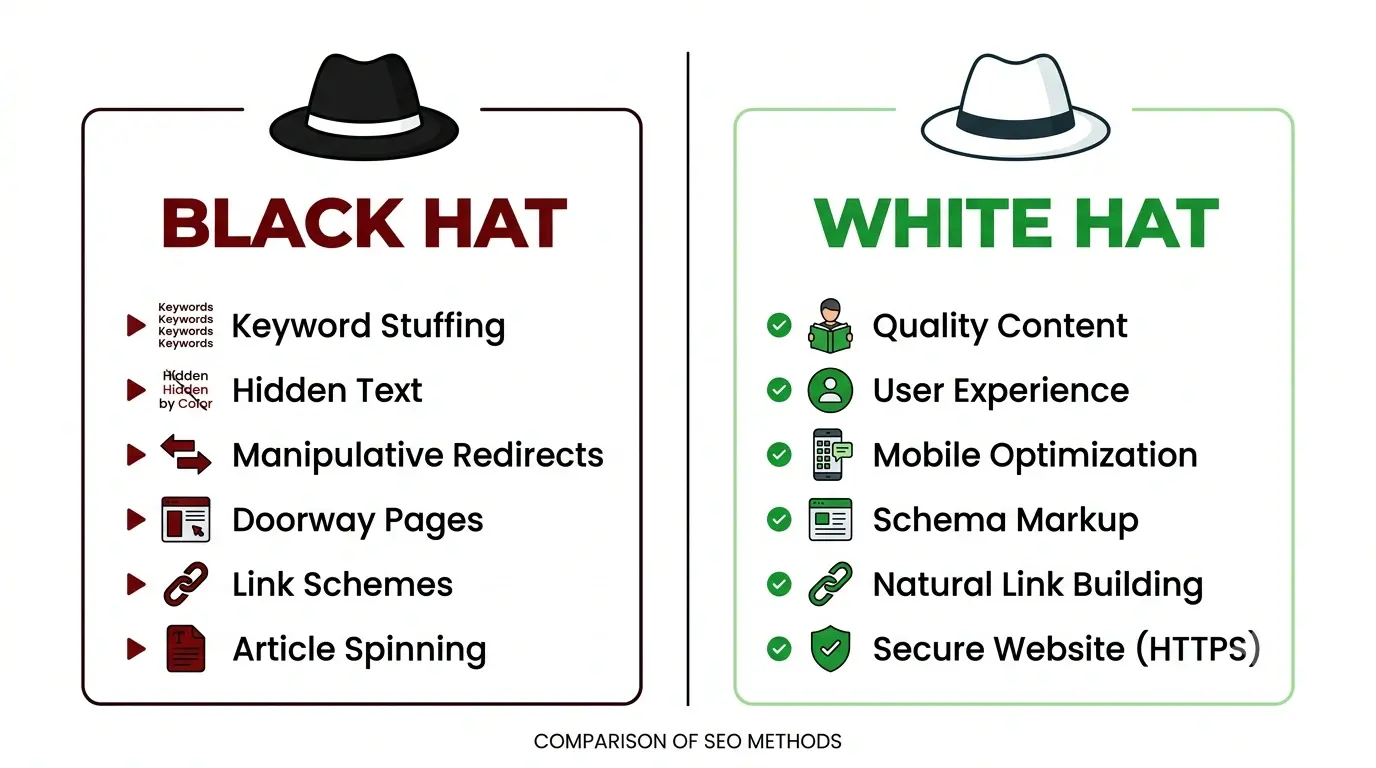 Black hat SEO is any tactic designed to gain rankings a site has not earned, usually by exploiting how search systems work. Many black hat SEO techniques match behaviors Google names in its spam policies:
- Keyword stuffing: repeating phrases unnaturally to influence rankings
- Cloaking: showing crawlers different content from what visitors see
- Hidden text and links: placing content only bots can find
- Doorway pages: near-identical pages built to rank, then push users elsewhere
- Sneaky redirects: sending visitors somewhere other than the indexed page
- Link spam: private blog networks, link farms and links sold to pass ranking value
- Scaled content abuse: mass-producing low-value pages, whether written by people or tools
- Scraping: copying other sites’ content to fill pages
- Site reputation abuse: hosting low-value third-party content on a trusted domain
- Expired domain abuse: buying old domains to borrow their past reputation
Not every violation is deliberate. A former freelancer may have built paid links years ago. A compromised plugin can inject hidden links without the owner knowing. An unmoderated comment section can fill with spam. Google’s systems judge the result on the page, not the owner’s intentions.
What Is Gray Hat SEO?
Gray hat SEO sits between the two: tactics that are not clearly banned today but lean toward manipulation. Examples include paying an editor to insert a link into an existing article, or publishing content mainly to attract links rather than help readers.
The risk is that the line moves. Expired domain abuse and site reputation abuse are now named spam policies, and tactics in those areas were once treated as clever shortcuts. Gray hat work can look safe right up until it is not.
White Hat vs. Black Hat vs. Gray Hat Comparison
| Factor | White Hat | Gray Hat | Black Hat |
| Guideline status | Compliant | Borderline | Violates |
| Primary audience | Readers | Readers and crawlers | Crawlers |
| Speed of results | Gradual | Moderate | Fast, often short-lived |
| Risk | Very low | Unpredictable | Very high |
| Cleanup needed | None | Sometimes | Heavy |
The practical goal is not to memorize labels. It is to understand white hat and black hat SEO as different approaches to creating and manipulating ranking signals.
The Hat Test: Score Any SEO Tactic in 60 Seconds
Before approving an SEO tactic, ask five quick questions:
- Does it improve the user’s experience?
If removing the SEO benefit would make you abandon the tactic, be cautious. - Does the tactic create genuine value?
A page should provide information, functionality, expertise, or a useful destination. - Is the tactic transparent?
If it relies on hidden elements, misleading redirects, or different content for Google and users, it deserves immediate scrutiny. - Is the ranking signal earned or manufactured?
Google’s link spam policy, for example, targets links created primarily to manipulate rankings. - Would you be comfortable documenting it?
A reliable SEO process should be explainable, repeatable, and auditable.
This 60-second test is especially useful when reviewing work from an outside SEO provider. You do not need to understand every technical detail to identify tactics based on manipulation rather than value.
Real Consequences of Black Hat SEO
Algorithmic Devaluation
Not every ranking decline is a manual penalty. Google’s systems continuously evaluate pages and sites, and broad core updates or other ranking changes can alter how pages perform in Search. Google advises site owners to investigate traffic changes using Search Console and other signals instead of immediately assuming they have received a penalty.
This distinction matters.
A page may lose visibility because its competitors became more useful, because search intent changed, because Google’s systems reassessed the page, or because problematic tactics were devalued. A ranking decline alone does not prove a manual action occurred.
Manual Actions
A manual action is different. Google says a manual action is issued when a human reviewer determines that pages do not comply with its spam policies. Affected pages or sites may rank lower or be omitted from Search, and the issue appears in the Manual Actions report in Search Console.
This can make spam cleanup more complicated because fixing one example may not be enough. Google advises fixing the issue across all affected pages before requesting a review.
Google’s 2026 Spam Updates: What We Actually Know
As of September 29, 2026, Google’s Search Status Dashboard lists multiple spam updates during 2026, including the March, June, August, and September spam updates, as well as March and May core updates.
The June 2026 spam update began June 24 and completed June 26. Google stated that it applied globally and across all languages.
The August 2026 spam update began August 18 and completed August 21, also applying globally and to all languages.
Most recently, the September 2026 spam update began on September 24. Google stated that it applies globally and to all languages, with a rollout that may take up to two weeks.
One important point is often missed: Google has not publicly stated that each update targets one specific tactic such as keyword stuffing or backlinks. Therefore, it would be misleading to claim that a particular 2026 spam update was exclusively designed to target one technique. The safer approach is to use Google’s published spam policies as the baseline and audit the site against them.
Google’s Search Essentials also continue to emphasize helpful, reliable, people-first content and compliance with spam policies.
How to Check Whether Your Site Has Been Hit
Run this 30-minute audit:
- Open the Manual Actions report in Search Console and confirm there are no issues.
- Compare clicks and impressions for two weeks before and after the update start date.
- Sort losing pages by type. Look for thin, templated or outdated pages.
- Review your backlinks for paid, irrelevant or unnatural patterns.
- Scan older pages for hidden text, unexpected redirects and injected links.
- Check for third-party content that does not fit your site’s purpose.
If the drop is site-wide and starts inside a confirmed update window, read Google’s spam policies before you change anything.
How to Recover From a Spam Penalty
Recovery depends on whether you are dealing with a manual action, algorithmic reassessment, technical problem, or another cause.
For a manual action, Google’s process is straightforward in principle: identify the violation, fix it across the affected pages, make sure Google can access the corrected pages, and then request a review through Search Console. Google recommends explaining what the issue was, what was changed, and what steps were taken to prevent the problem from recurring.
For an algorithmic decline, there is no generic “penalty removal” button. Instead, investigate the affected pages, identify weaknesses, improve usefulness and quality, remove manipulative practices, and monitor performance over time.
Do not replace one risky tactic with another. Recovery should make the website stronger even if a future update changes how rankings are calculated.
White Hat SEO Best Practices Checklist
Use these SEO best practices as a monthly routine:
- Give every page one clear intent and a complete answer.
- Show real authorship, first-hand experience and sources for factual claims.
- Keep pages fast, mobile-friendly and free of intrusive pop-ups.
- Use descriptive headings, alt text and logical internal links.
- Earn links with original data, tools and useful guides.
- Mark paid links with the sponsored attribute.
- Edit AI-assisted drafts with human fact-checking and added expertise.
- Remove or improve outdated, low-value pages.
- Check Search Console monthly for manual actions and sudden drops.
Following these SEO best practices will not guarantee first place, but it keeps your site safe while you compete.
Red Flags When Hiring an SEO Provider
Be careful if a provider:
- Guarantees a specific ranking or timeline
- Will not explain how they build links
- Sells bulk packages of cheap links
- Promises hundreds of AI-written pages every month
- Cannot show original work or earned coverage
- Will not give you access to your own reports
Ask every provider to run their methods through the Hat Test above. A good one will welcome the question. If you are comparing options, you can review our SEO Services in New York to see how ethical, long-term work is structured.
Final Thoughts
Black hat shortcuts trade long-term stability for a short spike. White hat work builds a site that gets stronger with every useful page. When a tactic feels uncertain, score it, write down why it helps visitors and choose the safer path.
If you want a growth plan with no penalty risk, contact us at LocalPro1 and we will review your site and build a strategy that lasts.
Frequently Asked Questions
What is white hat and black hat SEO?
White Hat SEO uses optimization methods that follow Google’s guidelines and focus on helping users. Black Hat SEO uses manipulative tactics intended to influence rankings in ways that conflict with Google’s spam policies.
Is White Hat SEO safer than Black Hat SEO?
White Hat SEO generally carries less risk of violating Google’s spam policies because it focuses on useful content, accessible websites, and legitimate optimization. Black hat SEO techniques can create greater policy and recovery risk when they involve manipulation such as cloaking, keyword stuffing, or link spam.
Are backlinks always a White Hat SEO technique?
No. A backlink is not automatically safe simply because it exists. Links created primarily to manipulate Google’s ranking systems can fall under Google’s link spam policies, while relevant links earned through valuable content or legitimate relationships can support discovery and reputation.
Can AI-generated content be Black Hat SEO?
AI itself is not the deciding factor. Google says scaled content abuse can include generating many pages with generative AI or other tools when the primary purpose is manipulating rankings and the resulting content provides little or no value to users.
What are the most important White Hat SEO techniques in 2026?
The fundamentals remain centered on helpful content, clear search intent, strong technical accessibility, useful internal linking, legitimate authority, and a good user experience. These white hat seo techniques are more sustainable than tactics designed around exploiting temporary ranking gaps.
Ready to Grow Your Business Online?
Get a custom strategy built around your goals. Our team will review your current marketing and show you exactly where the growth opportunities are.
- Free 30-minute strategy call
- Custom growth roadmap
- No obligation or hidden fees