Are Websites Built with AI Builders SEO-Friendly in the United States?

A small HVAC business in Ohio recently built its website in an afternoon using an AI builder. The site looked polished and professional, yet six months later it still had not reached page one of Google for a single service term in its city.
This scenario is far more common than most business owners realize, and it goes straight to the heart of a question worth answering clearly. Are websites built with AI builders SEO-friendly in the United States? At LocalPro1, we help US businesses solve this exact problem regularly, and this article explains why.
The Direct Answer
Yes, websites built with AI builders can be SEO-friendly in the United States, but only under specific conditions. An AI builder handling your layout, hosting, and initial content does not disqualify you from ranking well on Google. What decides your outcome is what happens after the build: whether the content is original, whether the technical foundation is solid, and whether the site satisfies real search intent rather than just looking finished. This article walks through what these tools handle well, where they consistently fall short, how Google’s August 2026 spam update changes the risk calculation, and the concrete steps that turn an AI-generated site into one that actually competes in search results.
What AI Website Builders Actually Do Well for SEO

It would be unfair to treat every AI builder as an SEO liability. Many of them handle the fundamentals reasonably well straight out of the box.
Mobile Responsiveness and Clean Code Output
Most modern AI builders generate mobile-responsive layouts automatically, which matters because Google indexes and ranks primarily based on the mobile version of a page. Clean, semantic HTML output also gives search engine crawlers less to trip over compared to older drag-and-drop platforms from a decade ago.
Basic On-Page SEO
AI builders typically auto-generate meta titles, meta descriptions, image alt text, and XML sitemaps based on the content you provide. These are genuine SEO basics, and having them in place by default saves a new website owner from missing the obvious.
Page Speed on Lightweight Templates
Because many AI-generated templates avoid heavy custom code or bloated plugin stacks, they can load faster than a poorly configured custom-built site. Page speed is one of Google’s ranking signals, so this is a real, if modest, advantage.
The takeaway here is that these tools give you a technically viable starting point. They do not give you a finished SEO strategy.
Where AI Builders Fall Short
This is where the gap between “the site exists” and “the site ranks” becomes obvious.
Duplicate or Templated Content Across Multiple Sites
When thousands of businesses describe similar services using the same AI builder, the underlying content structures and even phrasing patterns can end up strikingly similar across unrelated domains. Google’s systems are built to detect this kind of pattern, and it works directly against you.
Weak or Missing Schema Markup
Structured data helps Google understand what a page represents, whether it is a local business, a service, a product, or an FAQ. Many AI builders either skip schema entirely or apply a generic version that does not reflect your actual business details.
Generic, Thin Content That Doesn’t Match Real Search Intent
AI-generated copy often reads as competent but interchangeable. A page that could describe any plumbing company in any city does not answer the specific questions a searcher in Dallas or Phoenix is actually typing into Google.
Limited Technical Control
Custom redirects, canonical tag management, and advanced code edits are often locked behind platform limitations. If you later need to fix a duplicate content issue or migrate URLs, you may find the builder simply will not let you.
Core Web Vitals Issues on Heavier Builds
Some AI builders lean on JavaScript-heavy rendering for their visual editor, and if that carries over to the live site, Largest Contentful Paint and Interaction to Next Paint scores can suffer, particularly on mobile connections.
At LocalPro1, the technical audits we run on AI-built sites turn up this same combination of issues often enough that it has become a predictable pattern rather than an exception.
Google’s August 2026 Spam Update: Why This Matters Now
This is the part of the conversation most articles on this topic are missing entirely, and it is directly relevant if your site was built or is being built with AI tools right now.
What the Update Targets
Google’s August 2026 spam update, which rolled out globally between August 18 and August 21, 2026, was the third confirmed spam update of the year. Consistent with Google’s existing spam policies, this type of update focuses on scaled content abuse, which includes content mass-produced with automation, including AI, primarily to manipulate search rankings rather than to genuinely help users.
Why Templated AI-Builder Sites Are at Higher Risk
A site generated quickly with minimal editing, built on a template shared by thousands of other businesses, with content that has not been meaningfully rewritten to reflect real expertise or local relevance, fits the general profile these updates are designed to catch. This does not mean every AI-built site is penalized. It means the margin for shortcuts has narrowed.
A Practical Checklist to Stay Safe
Rewrite AI-generated copy so it reflects your actual business, your actual service area, and details a generic template could not know. Add genuine expertise signals such as credentials, years in business, or specific project examples. Avoid publishing large batches of near-identical location or service pages without substantive differences between them. These steps align directly with Google’s helpful, people-first content guidance and its E-E-A-T principles around Experience, Expertise, Authoritativeness, and Trustworthiness.
A Real-World Comparison: Before and After Optimization
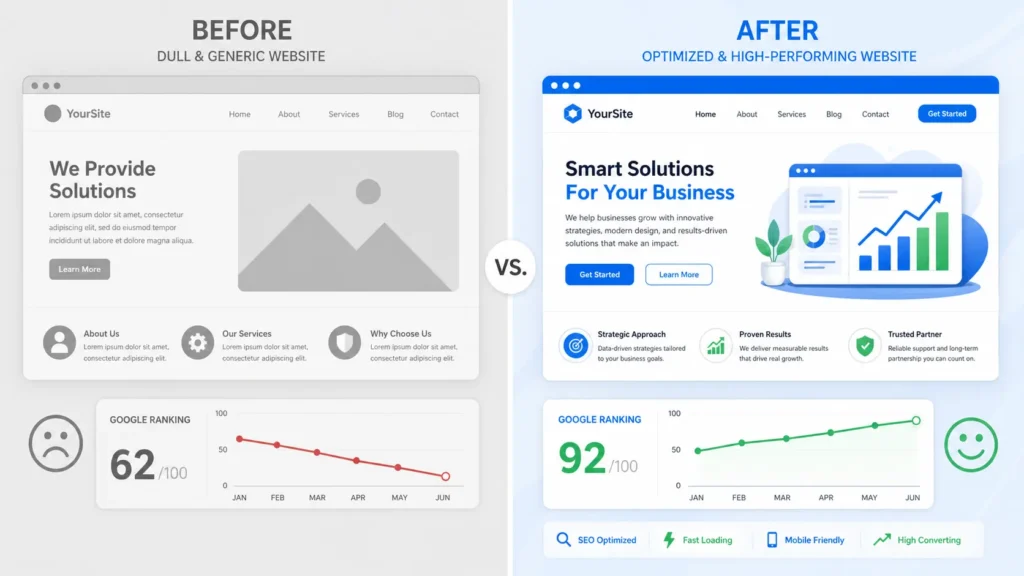
Consider a small landscaping business that launched an AI-built site with five template-generated service pages and no local content specificity. Indexed pages sat at four out of eleven after two months, and none ranked in the top 50 for any target term. After rewriting each service page with actual project details, adding location-specific FAQs, implementing LocalBusiness schema, and fixing a handful of broken canonical tags, all eleven pages were indexed within three weeks, and two service terms moved into the top 20 within the following month. Nothing about the underlying AI builder changed. What changed was the content depth and technical accuracy layered on top of it.
How to Make an AI-Built Website SEO-Friendly
If you already have an AI-generated site, or you are about to build one, here is the practical path forward.
Replace Generic AI Content With Original, Expertise-Driven Copy
Every page should say something a competitor’s page could not say verbatim. That might be a specific process you follow, a common problem you solve, or a detail only someone who does this work daily would know.
Add Proper Schema Markup
LocalBusiness, Service, and FAQ schema give Google structured signals about who you are and what you offer, which also improves your odds of appearing in AI Overviews and voice search results.
Fix Technical Gaps
Audit redirects, canonical tags, and URL structure. These are unglamorous fixes, but they are often the difference between a page that gets indexed correctly and one that quietly gets ignored.
Build Internal Linking and Topical Authority
Connect related service pages and blog content to each other with descriptive anchor text so Google understands how your content fits together as a topic cluster.
Treat SEO as Ongoing Work, Not a One-Time Setup
An AI builder gets you a website. It does not get you a search strategy that adapts as algorithms, competitors, and customer search behavior shift. If your business needs dedicated support with this, our AI SEO Services in New York team works specifically with AI-built and hybrid sites to close these gaps.
Should You Rebuild From Scratch or Just Optimize?
In most cases, a full rebuild is unnecessary. If your builder allows schema implementation, custom meta control, and reasonably clean code export, optimizing in place is usually faster and less risky. A rebuild becomes the better option when the platform itself blocks essential technical changes, such as canonical tag control or code-level access, that no amount of content editing can work around.
Final Thought
So, are websites built with AI builders SEO-friendly in the United States? The honest answer is that the builder is only the starting line, not the strategy. The businesses that succeed are the ones that treat their AI-generated site as a foundation to build on, not a finished product. If you want a clear picture of where your site currently stands and what it would take to compete for real search visibility, contact LocalPro1 and our team will walk you through it.
Frequently Asked Questions
Do AI-built websites include SEO features by default?
Most include basic SEO tools such as editable meta titles, meta descriptions, and automatic sitemap generation. Advanced features like custom schema or granular redirect control are often limited or unavailable depending on the platform.
Does AI-generated content violate Google’s spam policies?
Not automatically. Google’s policies target content mass-produced primarily to manipulate rankings rather than help users, so AI-assisted content that is edited, accurate, and genuinely useful is generally acceptable.
How long does it take for an AI-built website to get indexed?
This varies, but sites with thin or duplicate-pattern content often see delayed or partial indexing, while sites with unique, well-structured content tend to get indexed more consistently within the first few weeks.
Do AI builders support schema markup?
Some platforms offer basic schema options, but many require manual code additions or a third-party plugin to implement complete and accurate structured data.
Is a website built with AI builders SEO-friendly in the United States compared to a custom-coded site?
It can be equally competitive if the content and technical setup are handled properly, though custom-coded sites typically offer more flexibility for advanced technical SEO work.