



- Your cart is empty Browse Shop
How AI Overview Will Change SEO in 2026 (Complete Guide)

You checked Search Console and your rankings look fine. Same top positions, same keywords, nothing dropped. Yet your clicks are down. If that sounds familiar, you already know why you searched for how AI Overview will change SEO in the first place.
At LocalPro1, we’ve watched this scenario play out across client accounts over the past year, and it comes down to one thing: the page hasn’t lost its spot, but Google is now answering the question before the user reaches the results list. This isn’t a temporary glitch. It’s a structural change in how search works, and here’s what’s actually happening.
What Is AI Overview and How Does It Work
AI Overview is Google’s AI-generated summary that appears above traditional search results for many queries. Instead of forcing users to click through several links to piece together an answer, Google pulls information from multiple trusted sources, synthesizes it, and presents it directly on the page, often with a few source links tucked beneath.
For years, results followed a familiar format: ten blue links, maybe a featured snippet. That format is now reshaped, with the AI-generated answer sitting at the top and pushing traditional listings further down. Users can still scroll and click, but many don’t need to. That single change is at the center of the impact of AI Overviews on SEO that every site owner is dealing with.
What Real Impact Is AI Overview Having on SEO
The most measurable effect is a decline in organic click-through rates. Data varies by query and vertical, but a consistent pattern holds: when an AI Overview appears, fewer users scroll to click an organic listing, even one holding the top position. Some publishers have reported double-digit percentage drops for pages that kept identical rankings before and after AI Overview rolled out for their queries.
This connects to the zero-click search trend, where users get an answer instantly and leave without visiting a site. It’s convenient for the searcher, but it changes what ranking well actually delivers for a business.
Not every industry feels this equally. Queries in the Your Money, Your Life space- think health, finance, and legal topics- see AI Overviews less often, since Google is more cautious about summarizing high-stakes advice. General informational and how-to queries are far more likely to trigger a full AI-generated answer.
Which Industries Are Most Affected
- Technology and software explainer content
- Health and wellness informational queries (limited by YMYL caution)
- How-to and DIY guides
- General knowledge and definitional searches
The Core Difference Between Traditional SEO and AI-Era SEO

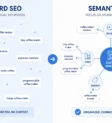
Traditional SEO rewarded keyword density and close term-matching. That approach is losing relevance. What matters now is topical depth and genuinely satisfying intent, not just matching phrasing.
The ranking model has also changed shape. Previously, one page won the top spot and captured the most clicks. In the AI Overview model, several sources often get cited within a single generated answer, so visibility is distributed instead of concentrated. This is one of the clearest examples of what AI Overviews mean for SEO in practice: “ranking #1” and “being cited in the AI answer” are now two separate, sometimes disconnected, goals.
How to Get Cited in AI Overview (Core Strategy)
This is the part that actually moves the needle. Structure content so it can be scanned and extracted easily. Short paragraphs, clear descriptive headings, and a direct answer near the top of each section all help. Google’s systems look for the cleanest, most extractable version of an answer, and messy content rarely makes the cut. Answer the core question within the first one or two sentences of a section. Readers and AI systems both reward directness. Save supporting detail and nuance for the paragraphs that follow.
Add something that can’t be found on ten other pages saying the same thing. That might be an original framework, a proprietary process, a specific operational insight from working with real clients, or a genuinely different angle. Generic restating of common knowledge rarely earns a citation when competing pages already say the same thing. Finally, aim for comprehensive coverage rather than several thin pages targeting narrow keyword variations. One well-built article answering the primary question and its related sub-questions tends to outperform five shallow ones.
Content Structure That AI Overview Favors
- A short, direct-answer opening for each major section
- FAQ-style blocks that mirror natural search phrasing
- Lists and tables for comparative or step-based information
- A clean, logical H2/H3 hierarchy
- Schema markup that reinforces the page’s structure
The Growing Importance of E-E-A-T and Trust Signals
Experience, Expertise, Authoritativeness, and Trust carry more weight now. AI Overview tends to lean on sources that demonstrate real credibility rather than generic content farms. That means visible author credentials, original research where it makes sense, and content that reads like it was written by someone who has actually done the work.
This is where the impact of AI Overviews on SEO becomes an opportunity rather than only a threat. Sites investing in demonstrable expertise are positioned to be the sources AI systems choose to cite, while thin or recycled content gets filtered out. Our team at LocalPro1 builds this kind of depth into every content strategy we run for clients.
The Role of Structured Data and Schema Markup
Structured data doesn’t guarantee inclusion in an AI-generated answer, but it makes it easier for search systems to understand what a page is about. FAQ schema, HowTo schema, and Article schema each give explicit signals about the content’s format and purpose. It won’t fix weak content, but on strong content, it removes friction between what you’ve written and how it gets interpreted.
The Impact of Google’s August 2026 Spam Update on SEO
Google’s August 2026 spam update was the third spam-focused update of the year, and it didn’t introduce a new spam policy category. What it reinforced, building on an earlier May 2026 clarification, is that Google’s spam policies also apply to attempts to manipulate AI-generated responses, not just traditional rankings. Tactics designed to game an AI Overview citation carry the same risk as tactics designed to game a traditional ranking.
The takeaway is straightforward: avoid generic, mass-produced content built purely to trigger a citation, and make sure every published page adds real, verifiable value.
What to Do After a Spam Update
- Compare Search Console performance before and after the rollout date
- Audit older content for thin, outdated, or auto-generated pages
- Check for duplicate content across your site and consolidate where needed
Search Everywhere Optimization – Don’t Limit Yourself to Google
AI systems increasingly draw from a wider pool of sources than a single search engine’s index, including video platforms, forums, and review sites. Building presence beyond Google alone helps ensure your brand shows up in the broader information ecosystem these systems pull from.
Why Brand Authority and Presence Now Matter More Than Traffic
Traffic used to be the primary scoreboard for SEO success. That’s changing. Being mentioned or referenced, even without a click, still builds brand recognition and trust. Digital PR, genuine customer reviews, and a consistent multi-channel presence all contribute to a brand being recognizable enough that users and AI systems treat it as a credible source.
You may also read: Are Websites Built with AI Builders SEO-Friendly in the United States?
Common Mistakes That Hurt Rankings in the AI Search Era
- Keyword stuffing instead of naturally covering a topic
- Thin or generic content that repeats what’s already widely available
- Fake reviews or unverifiable claims about results and experience
- Bulk AI-generated content published without originality or editing
- Misapplied structured data that doesn’t match the actual page content
What to Do Next – Actionable Checklist
Audit your highest-traffic pages for structure: are answers clear and near the top, or buried in long intros? Identify where you can add something genuinely original, whether that’s data, a real example, or an expert perspective. Strengthen E-E-A-T signals with visible author information and credible sourcing. Add relevant schema where it fits naturally, and keep measuring citation visibility alongside traditional rankings, since both now matter for a complete picture of performance. If this feels like more than your team can manage alone, our AI SEO Services in New York can help turn this strategy into an execution plan.
Final Thought
Understanding what AI Overviews mean for SEO isn’t about chasing a trend; it’s about adapting to how people actually search now. Businesses that build real depth, trust, and originality into their content will be the ones AI systems choose to cite, and the ones users choose to trust. If you’d like help auditing your content and building a strategy around this shift, contact us at LocalPro1, and we’ll walk through what it looks like for your site.
FAQs About AI Overview and SEO
Will AI Overview replace traditional SEO entirely?
No. Traditional organic results still exist below AI Overview, and many queries don’t trigger an AI-generated answer at all. What’s changing is the strategy needed to earn visibility in both places at once.
How long should content be to get cited in AI Overview?
There’s no fixed word count requirement. What matters more is whether the content answers the query clearly and completely, without unnecessary padding.
Can small or local businesses still show up in AI Overview results?
Yes. Citation depends on relevance and trust signals, not company size. A well-structured, genuinely useful local page can be cited just as easily as a page from a much larger site.
Does AI Overview mean less organic traffic for everyone?
Not universally. YMYL categories like health and finance see less AI Overview coverage, and pages that earn citations can gain new visibility they wouldn’t have had otherwise.
How do I know if AI Overview is affecting my specific pages?
Compare click-through rates for queries where you rank well against your historical baseline, and check whether AI Overview appears for those queries. A stable ranking with a falling CTR is usually the clearest signal.
