




- Your cart is empty Browse Shop
What Are the Benefits of SEO?
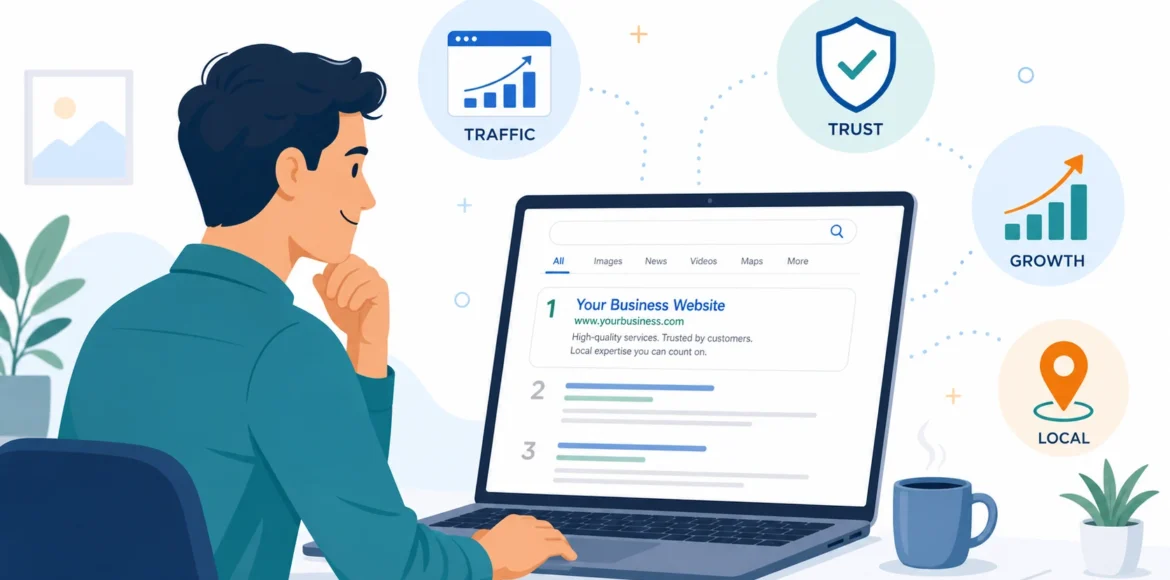
Right now, someone is typing a question into a search bar that your business could answer. If your page isn’t there, they will read a competitor’s page instead, and you will never know it happened. So, what are the benefits of SEO for a business that wants steady, predictable growth? At LocalPro1, we see the same pattern again and again: the businesses that treat search visibility as an asset, not a one-off task, keep winning customers long after their campaigns end.
SEO, or search engine optimization, is the practice of making your website easier to find, understand, and trust for both people and search engines.
Key Takeaways
- SEO brings visitors who are already looking for what you offer.
- Its costs are front-loaded, but the returns can keep building for years.
- Good SEO improves your site for real users, not only for ranking systems.
- Results take months, not days, and shortcuts can backfire.
- The biggest SEO benefits show up when content, technical health, and trust work together.
What Is SEO and How Does It Work?

SEO is the process of improving a website so search engines can find its pages, understand what they cover, and show them to people whose questions they answer best. It combines useful content, a healthy technical setup, and signals of trust.
At LocalPro1, we describe the process in three plain steps:
Crawling → Indexing → Ranking
- Crawling: automated programs follow links to discover your pages.
- Indexing: the search engine stores and organises what it found.
- Ranking: when someone searches, it picks the pages it judges most helpful.
Understanding this chain matters because problems can happen at any step. A page that can’t be crawled can’t rank, no matter how good it is. This is why the benefits of search engine optimization come from fixing the whole chain, not only writing articles.
You may also read: What Is SEO and How Does It Work?
10 Key Benefits of SEO
Here are the main advantages of SEO, with a practical example for each. The examples are illustrative scenarios, not case studies.
1. Targeted Organic Traffic
Search traffic is intent-driven. A person searching “emergency boiler repair” wants a repair, not a browse. Imagine a heating contractor who publishes a clear page for that exact problem. The visitors arriving are already in the buying mindset.
2. Cost-Effective, Long-Term Growth
Paid ads stop delivering the moment the budget stops. A well-built page can keep attracting visitors for years with only periodic updates. The upfront work is real, but the cost per visit tends to fall over time as the page keeps earning its place.
3. Trust and Credibility
People tend to trust pages that appear on the first page of results, because they assume the search engine vetted them. Trust also comes from what you publish: clear authorship, honest claims, and accurate information. Ranking is partly a reward for earning that trust.
4. Better User Experience
Many SEO tasks are also usability tasks. Faster loading, mobile-friendly layouts, clear navigation, and readable pages help visitors as much as they help rankings. One of the quiet SEO benefits is that you end up with a better website overall.
5. Higher-Quality Leads and Conversions
Because search visitors arrive with a specific need, they are often easier to convert than people interrupted by an ad. A law firm’s page on “how to contest a parking fine” attracts people who may need a lawyer soon, not people who are casually scrolling.
6. 24/7 Visibility
Your website answers questions at 2 a.m. on a Sunday. For a small team, this means enquiries can arrive outside office hours, ready for the next working day.
7. Local Visibility
For businesses serving a specific area, local search is often the most valuable channel. Accurate business listings, consistent name, address and phone details, and genuine customer reviews help you appear when people search “near me.” A dentist who keeps opening hours updated avoids sending patients to a closed door, which protects both rankings and reputation.
8. Measurable Results
You can track impressions, clicks, queries, and conversions through Search Console reports and analytics. This makes SEO easier to manage than many traditional channels. You can see which pages bring enquiries and which need work.
9. Competitive Advantage
If a competitor answers a customer’s question first and better, they collect the trust that follows. Publishing helpful content about topics your rivals ignore, such as pricing factors, common mistakes or edge cases, gives you a lead that is hard to copy quickly.
10. Brand Awareness and AI-Search Readiness
AI-generated answers pull from pages that are clear, well-structured, and trustworthy. Direct answers, descriptive headings, and accurate facts make your content easier to extract and cite. There is no guarantee of being cited, but unclear pages are rarely chosen.
Who Benefits Most From SEO?
The advantages of SEO vary by business model. Here is where each type usually feels them first.
| Business type | Main benefit | Where to start |
| Bloggers and publishers | Steady audience growth | Cover topics deeply and keep them updated |
| Local businesses | Calls and visits from nearby searchers | Complete business listings and location pages |
| E-commerce stores | Product discovery | Unique product descriptions and clean site structure |
| Freelancers and service providers | Qualified enquiries | Service pages that answer specific client questions |
| SaaS and B2B companies | Trust with longer buying cycles | Problem-focused guides and comparison pages |
SEO vs. Paid Advertising: Which Is Better?
SEO and paid advertising solve different problems. The right mix depends on timing, budget, competition, and business goals. These advantages of seo do not make paid ads irrelevant.
| Factor | SEO | Paid advertising |
| Cost | Investment in content, technical work, and optimization | Ongoing spend for clicks or impressions |
| Speed | Usually slower to build | Usually faster to launch |
| Sustainability | Pages can continue earning organic visibility | Traffic generally depends on active spend |
| Control | Less direct control over rankings | More control over targeting and budget |
| Best use | Long-term organic demand | Immediate visibility, testing, or launches |
Paid campaigns can provide immediate feedback, while SEO builds a longer-term organic asset.
How Long Does SEO Take to Show Results?
There is no universal 30-day SEO timeline. Some technical improvements can produce earlier changes, while meaningful growth in competitive markets may take several months or longer.
Timing depends on site history, competition, technical condition, content quality, internal linking, authority, publishing consistency, and search intent. A new site competing for a difficult commercial query should not be judged like an established site fixing an indexing problem.
A better measurement sequence is technical health first, then indexing and relevant impressions, then qualified clicks, and finally leads, sales, or other business outcomes.
Common Mistakes That Cancel Out SEO Benefits
Search engines have become firmer about low-value tactics, and their published spam policies cover many of them. Avoid these:
- Mass-producing pages without human review. Volume without added value is a risk, not a strategy.
- Keyword stuffing. Repeating a phrase unnaturally makes text worse for readers.
- Copied or lightly reworded content. If a page adds nothing new, there is no reason for it to rank.
- Misleading promises. Claims like “guaranteed first position” are a warning sign.
- Low-quality third-party content published only to rank. Hosting content that has nothing to do with your site’s purpose can harm trust.
- Link schemes. Buying or swapping links to manipulate rankings can lead to penalties.
The safest position is simple: publish what genuinely helps your audience, and be able to explain why each page exists.
How to Get Started: A 5-Step Action Plan
- Research keywords and intent. List the questions your customers actually ask, then note whether they want information, a comparison, or a purchase.
- Create helpful, original content. Answer the question directly, then add examples, edge cases, and practical advice from real experience.
- Fix the basics. Check page speed, mobile display, clear headings, and internal links between related pages. If you’d rather have specialists handle this, our SEO Services in New York cover audits, content, and technical fixes.
- Earn authority naturally. Create resources worth referencing, and build genuine relationships with relevant sites and communities.
- Track and improve. Review which queries and pages perform, then update what is underperforming. SEO rewards steady refinement.
Final Thought
So, what are the benefits of SEO in one line? Targeted visitors, lasting returns, stronger trust, and clear measurement, all built on being genuinely useful. The benefits of search engine optimization grow when you avoid shortcuts and keep improving. If you want a clear plan for your website, contact us at LocalPro1 and let’s talk about where to begin.
Frequently Asked Questions
Is SEO free?
Organic clicks are free, but SEO is not. It takes time, skill, and often budget for content, technical work, or expert help. The trade-off is that the cost per visit can drop as your pages mature.
How long does SEO take?
Most sites need several months to see meaningful movement, and competitive topics can take longer. Progress depends on your starting point, your niche, and how consistently you improve your site.
Is SEO still worth it with AI search?
Yes. AI-generated answers rely on clear, accurate, and well-organised pages, which are the same qualities good SEO promotes. Many SEO benefits, such as trust and topical depth, also help your content get considered for those answers.
What is the difference between SEO and SEM?
SEO focuses on earning unpaid visibility in search results. SEM is a broader term that usually includes paid search advertising alongside SEO. Many businesses use both.
Is SEO worth it for small businesses?
Often, yes, especially for local and service businesses. The advantages of SEO for small teams include steady enquiries without a large ad budget, provided you target realistic, specific searches.
