




- Your cart is empty Browse Shop
What Is AEO and GEO? The Complete 2026 Guide
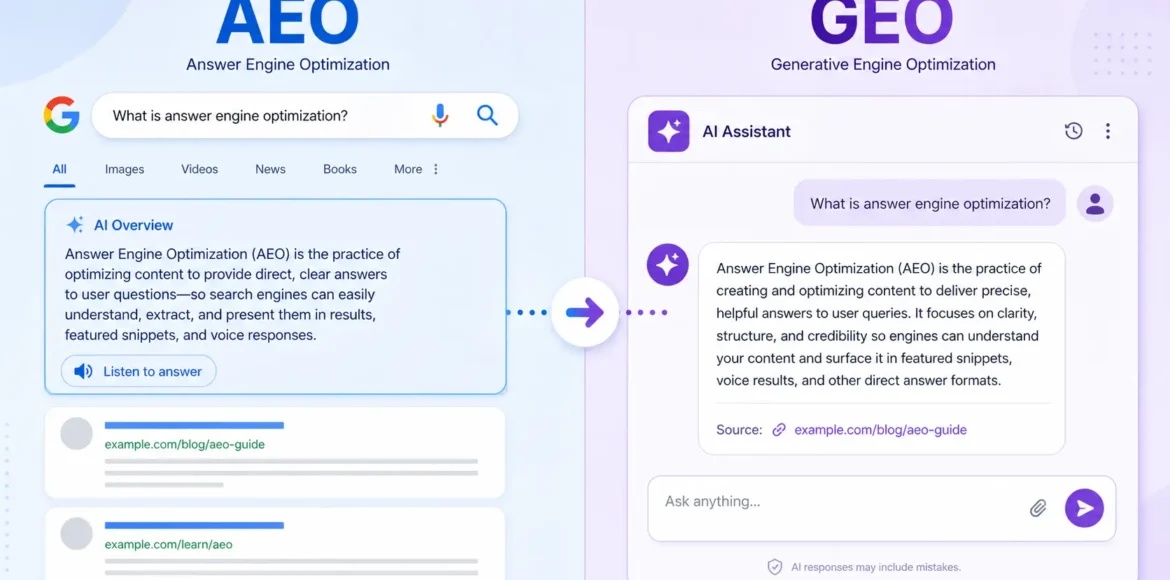
Type a question into Google today, and there’s a good chance you get your answer before you ever see a blue link. That’s why so many business owners now ask what AEO and GEO are. Here’s the real problem: a business can rank number one and still watch traffic decline because the page was never selected as the answer inside an AI Overview or ChatGPT response.
At LocalPro1, we see this exact pattern across New York client accounts: strong rankings, quiet click drops. Understanding what AEO in digital marketing is now essential, since search engines, AI chat tools, and voice assistants all pull from the same content in very different ways.
Quick Answer
AEO (Answer Engine Optimization) structures content so search engines can extract it as a direct answer in featured snippets, People Also Ask boxes, and AI Overviews. GEO (Generative Engine Optimization) goes further, shaping how content gets cited inside AI-generated responses from tools like ChatGPT, Gemini, and Perplexity. Together, they determine whether your business gets found or gets skipped in 2026’s AI-driven search landscape.
What Is AEO (Answer Engine Optimization)?

AEO stands for Answer Engine Optimization. The AEO meaning, in plain terms, is the practice of structuring web content so that search engines can pull out a clear, self-contained answer and display it directly to the user, often without a click.
If someone asks what AEO in marketing is, the short version is this: it is the discipline of writing and formatting content so an algorithm can lift a specific sentence or short passage and present it as the answer, rather than making the user dig through a page to find it. This is different from writing for humans alone. A page can be well written and still fail at AEO if the answer to the main question is buried three paragraphs deep, wrapped in soft or uncertain language.
Where AEO Shows Up
AEO is not one single feature. It shows up across several search surfaces, and each one behaves a little differently:
- Featured snippets, the boxed answer that appears above organic results, usually pulled from a short paragraph or numbered list.
- People Also Ask boxes, expandable question sets tied to a search query, often showing four or five related questions.
- Google AI Overviews, the AI-generated summary that now appears for a large share of searches, blending information from multiple sources into one answer
- Voice search results, where a smart speaker reads out a single answer with no visual options to compare, meaning your content either wins the spot completely or is not heard at all
A useful way to think about what AEO stands for in practical terms: it stands for the shift from ranking for a click to ranking for a direct answer. A dentist’s office in Queens does not need to rank first for “root canal cost” if their content is the one voice assistants read aloud when a patient asks the same question out loud on their kitchen speaker. That single moment, not the ranking position, is what determines whether the practice gets the call.
What Is GEO (Generative Engine Optimization)?

GEO stands for Generative Engine Optimization. Where AEO focuses on being extracted, GEO focuses on being cited and trusted inside a generated response, even when there is no traditional search results page involved at all.
When someone asks a broader question like what is AEO and GEO together, the cleanest distinction is this: AEO is about answer extraction on search engines, while GEO is about earning a mention inside an AI system’s synthesized response, built from many sources at once rather than a single ranked page. A business can win at AEO and still lose at GEO, because the two systems weigh different signals when deciding what to surface.
Where GEO Shows Up
GEO plays out across the generative AI tools people now use as a starting point for research, often before they ever open a traditional search engine:
- ChatGPT, when it references a source while explaining a topic or comparing options
- Perplexity, which shows inline citations by design, making source selection highly visible
- Google Gemini, inside conversational search sessions where follow-up questions shape which sources get pulled next
- Microsoft Copilot, which pulls heavily from Bing’s index and favors well-structured, fact-dense pages
A local example makes this concrete. A Brooklyn moving company we worked with noticed that ChatGPT users were being told about moving cost ranges sourced from a completely different city’s pricing data. The business had accurate, current pricing on its own site, but nothing about the page signaled it as a trustworthy, citable source: no clear author, no recent update date, no specific service-area detail. That is a GEO gap, not a ranking gap, and no amount of traditional keyword work would have fixed it.
SEO vs AEO vs GEO: What’s the Difference?
These three disciplines overlap, but they solve different problems. Here is how they compare side by side:
| Factor | SEO | AEO | GEO |
| Primary goal | Rank on the search results page | Get extracted as a direct answer | Get cited inside AI-generated responses |
| Where it appears | Organic search listings | Snippets, PAA, voice search | ChatGPT, Perplexity, Gemini, Copilot |
| Core signals | Keywords, backlinks, technical health | Clear structure, direct answers, schema | Citations, entity authority, freshness |
| User outcome | Clicks to your website | Answer without a click | Your brand mentioned without a visit |
SEO is the foundation. Without it, a page has no authority to build on. AEO and GEO sit on top of that foundation, targeting the two newest ways people now find information, and this is really the core of AEO and GEO when you strip away the jargon: two extensions of search visibility built for a world where fewer people click through at all.
Why AEO and GEO Matter Now
Search behavior has changed faster in the past two years than in the previous decade. AI-generated answers now appear for a large share of searches, and when they do, the click-through rate to traditional organic results drops sharply, in some studies by well over half compared to a standard results page. That is not a small dip. For a business relying on organic traffic to generate leads, it can mean the difference between a full calendar and a quiet month.
At the same time, more people are skipping the search engine entirely and opening an AI chat tool directly to ask their question. If your content was never built with citation in mind, it simply is not part of that conversation, no matter how well it ranks on Google. This is also why understanding what AEO in digital marketing matters beyond the marketing team is important; it now touches how sales leads arrive, how customer questions get pre-answered before a call, and how much organic traffic a website can realistically expect going forward.
This is exactly why LocalPro1 treats AEO and GEO as standard parts of every SEO engagement now, not as an optional add-on. A page that ranks but is never chosen as an answer is leaving performance on the table.
How AEO and GEO Actually Work
Both disciplines follow a similar three-step process, even though the platforms behind them differ:
- Retrieval: The search engine or AI model pulls a set of relevant pages based on the query, using traditional ranking signals as the first filter.
- Extraction or synthesis: Traditional search engines extract a specific passage word for word. AI models synthesize information from multiple sources into one new response, often blending three or four pages.
- Citation or display: The chosen answer either gets displayed directly (AEO) or referenced as a source within a generated reply (GEO), sometimes with a visible link and sometimes without one.
The pages that win at each step share a pattern: the answer is easy to find within the content itself, phrased with confidence rather than vague qualifiers, and backed by specific, checkable details rather than broad claims. A page that says “costs vary depending on many factors” loses to a page that says “costs typically range from X to Y depending on square footage and material choice.”
Step-by-Step: How to Optimize for AEO
- Answer the question in the first 40 to 60 words. Do not bury the direct answer under three paragraphs of introduction. Readers and algorithms both reward pages that respect their time.
- Use structured data markup. FAQ schema and HowTo schema give search engines a machine-readable version of your answer, which increases the odds it gets pulled into a snippet.
- Write in confident, factual language. Sentences using “may” or “could” are extracted less often than direct statements built around specific numbers and facts.
- Organize content around entities, not just keywords. Define who or what you are talking about clearly, rather than relying on pronouns that a machine cannot easily resolve.
- Use descriptive subheadings that mirror how real users phrase their questions, since these headings are often what search engines scan first when deciding what a page is really about.
If your team does not have the capacity to rebuild older content around these principles, this is precisely the technical and structural work our SEO Services in New York team handles for clients across every borough, from initial content audits through full implementation.
Step-by-Step: How to Optimize for GEO
- Include original data or examples AI systems cannot find elsewhere. Generic summaries rarely get cited; specific, sourced details do, especially numbers tied to your own operations.
- Add short, quotable statistics or findings. Research shows that adding credible quotations and statistics can meaningfully increase how often a source gets referenced in generated answers.
- Build entity authority. Consistent business information, author credentials, and clear “about” content help AI systems trust a source over one with no visible ownership.
- Publish across multiple credible surfaces, not just your own website, since generative engines pull from a wider pool of sources than traditional search, including industry directories and press coverage.
- Keep content fresh. Outdated statistics and pricing get quietly dropped from AI-generated answers, even on otherwise strong pages that once ranked well.
Common Mistakes to Avoid
Once a business understands what AEO is in marketing, the natural next step is trying to act on it quickly, and that is exactly where a lot of businesses damage their own visibility while chasing AEO and GEO gains. Avoid these:
- Stuffing FAQ sections with fake questions nobody actually searches for, to trigger extraction. This has become a flagged pattern under recent spam policy updates.
- Publishing thin, templated content at scale, hoping volume alone will win citations. Scaled, low-value content is one of the clearest targets of recent spam updates.
- Ignoring E-E-A-T signals. Experience, expertise, authoritativeness, and trust still matter, arguably more now, since AI systems weigh source credibility heavily when deciding what to cite.
- Copying competitor structure word for word. Search quality evaluators and AI systems both penalize content that adds no original value beyond what already exists elsewhere.
- Treating AEO and GEO as one-time projects. Both require ongoing monitoring, since AI Overview triggers and citation patterns shift monthly, sometimes even week to week for competitive topics.
Key Takeaways
- The AEO meaning, at its core, is about being chosen as the answer, not just being listed as an option.
- AEO gets your content extracted as a direct answer on search engines.
- GEO gets your content cited inside AI-generated responses from tools like ChatGPT and Gemini.
- Both rely on strong SEO fundamentals, clear structure, and original, trustworthy content.
- Confident, factual language and structured data improve extraction and citation odds.
- Avoiding spam tactics and thin content matters more than ever under current Google guidelines.
Final Thought
Search is no longer just about ranking on a results page. It is about being the answer, whether that answer appears in a snippet, gets read aloud by a voice assistant, or shows up as a citation inside an AI-generated response. Understanding what AEO and GEO are is now a baseline requirement for any business serious about staying visible in 2026 and beyond.
If you are ready to build a content strategy that performs across traditional search, AI Overviews, and generative engines, LocalPro1 can help you get there. Contact us today for a free consultation, and let our team show you exactly where your current content is losing visibility and how to fix it.
Frequently Asked Questions
What is the difference between AEO and GEO?
AEO focuses on getting content extracted as a direct answer on search engines, through snippets, voice search, and AI Overviews. GEO focuses on getting content cited or referenced inside AI-generated conversations, such as ChatGPT or Gemini responses.
Is AEO the same as SEO?
No, though they are closely related. Traditional SEO focuses on ranking a page in search results, while AEO focuses on making a specific answer easy to extract from that page, regardless of its overall ranking position.
What does AEO stand for exactly?
AEO stands for Answer Engine Optimization, the practice of structuring content so it can be pulled out as a direct, standalone answer by search engines and voice assistants rather than requiring a click to a full page.
Why is GEO important in 2026?
GEO matters because a growing share of research now starts inside AI chat tools instead of a traditional search engine. If your content is not structured to be citable, your business becomes invisible in that entire channel of discovery.
How do I optimize content for AI Overviews?
Lead with a direct, confident answer near the top of the page, use structured data, and organize the page around clear entities and facts rather than vague, keyword-stuffed phrasing.
Does Google penalize AI-generated content for AEO and GEO purposes?
Not simply for being AI-assisted. Google’s current spam guidance targets manipulation of generative AI responses and thin, unoriginal content specifically, meaning quality and originality matter far more than how the content was produced.
