



- Your cart is empty Browse Shop
On Page vs Off Page SEO: Which Matters More in 2026?
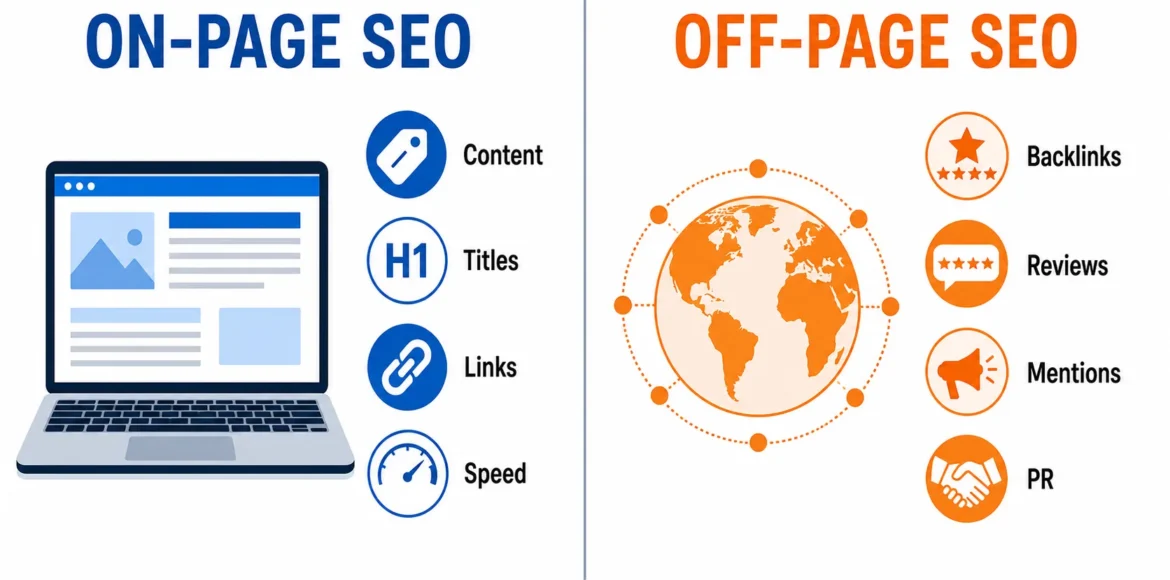
When rankings stall, most owners blame the wrong thing. Some rewrite every title tag, while others buy a pile of links. Both reactions often miss the real problem. The on page vs off page seo debate is not about picking a winner. On-page work decides whether your page deserves to rank, and off-page signals decide whether Google trusts it enough to place it above competitors.
At LocalPro1, we see this confusion most with service businesses that have a decent website but no clear idea what to fix first. With the latest Google spam update rolling out, order matters more now.
Quick Answer: Which Matters More?
On-page SEO matters more first, because weak pages waste every link you earn. Off-page SEO matters more later, because in competitive results, trust and authority usually break the tie between pages of similar quality.
TL;DR
- Fix on-page first. It is faster, cheaper and fully in your control.
- Add off-page work when your content is good but you are stuck below the top results.
- Avoid shortcuts. Spam enforcement is active, and shortcuts are the quickest way to lose visibility.
What Is On-Page SEO?
On-page SEO is everything you change on your own website to help a page match what searchers want and help search engines understand it. It covers content, structure and technical experience.
A practical on-page SEO checklist looks like this:
- Content that matches the search intent behind the query
- Clear title tags and meta descriptions
- Logical headings and page structure
- Internal links that point to your important pages
- Clean URLs
- Compressed, properly described images
- Fast loading and a comfortable mobile layout
- Structured data where it fits the page
The biggest advantage is control. You can change a page today and see how it performs within weeks, without waiting for anyone else to link to you. If you want a professional audit of these elements, our On-Page SEO Services in New York cover them page by page.
You may also read: What Is On-Page SEO?
What Is Off-Page SEO?
Off-page SEO is the set of signals that happen outside your website and shape how credible your brand looks to search engines and to people.
Effective off-page SEO strategies include:
- Editorial backlinks from relevant sites
- Brand mentions, even without a link
- Digital PR built around something newsworthy
- Genuine guest contributions on topic-relevant publications
- Content distribution and social sharing
- Local citations and customer reviews
- Honest participation in communities and forums
You cannot fully control any of these. Another site decides whether to link to you, and a customer decides what to write in a review. That is exactly why these signals carry weight: they are harder to fake than a title tag.
You may also read: What Is Off-Page SEO?
On Page vs Off Page SEO: Key Differences

| Factor | On-Page SEO | Off-Page SEO |
| Control | Full | Partial |
| Speed of results | Often weeks | Often months |
| Cost | Mostly time and skill | Time, outreach and sometimes budget |
| Risk level | Low if content stays useful | Higher if you chase shortcuts |
| Long-term impact | Solid foundation | Compounding authority |
| Examples | Rewriting a thin service page | Earning a mention in a local news story |
The takeaway is simple. On-page SEO is what you do. Off-page SEO is what others say about you. You need both, but not at the same time and not in equal amounts.
Which Matters More? The Honest Answer
Why On-Page Comes First
Think of a roofing company that earns a link from a local home-improvement blog. The link points to a service page with three short paragraphs, no pricing context, no service area details and no photos. A visitor lands there, finds nothing useful and leaves. The link did its job, but the page failed.
A strong page converts attention into rankings and leads. A weak page wastes it. Pages that satisfy search intent also keep visitors reading, which supports everything else you do.
Why Off-Page Becomes the Deciding Factor
Now picture two accounting firms with equally helpful pages for the same query. Google still has to choose an order. Signals such as relevant backlinks, consistent brand mentions and real reviews help it decide which business is more established and trusted.
Brand mentions also matter for AI-generated answers. When a business is mentioned across reputable places, it becomes easier for generative systems to recognize it as a real entity worth citing.
How to Decide Where to Focus
At LocalPro1, we usually start with a diagnostic rather than a plan, because the right answer depends on where the site stands today.
Use these scenarios as a guide:
- Brand-new website: Start on-page. You have no authority to build on yet, so make every page clear, useful and technically sound.
- Good content but stuck on page two: Add off-page work. Your pages probably deserve better, and authority is the missing piece.
- Local business: Combine on-page work with reviews and accurate citations. Local results lean heavily on trust signals from customers.
- Traffic drop after an update: Audit both sides. Check for thin or mass-produced pages first, then review your link profile for anything unnatural.
Here is a quick self-check:
- Does each page match what searchers actually expect to see for its query?
- Does your page get impressions but few clicks? That points to titles and snippets, which is an on-page issue.
- Does it rank on page two with decent clicks when it appears? That points to authority.
- Do competitors have noticeably more relevant mentions than you?
One more practical test: search your main keyword and look at the top five results. If they are all guides and your page is a sales page, the problem is search intent, and no amount of backlink building will fix a mismatch.
How the Google Spam Update Affects Both
Google released its September 2026 spam update on September 24. It applies globally and to all languages, and Google said the rollout could take up to two weeks. It is not described as a link spam update, and Google has not shared which specific tactics it targets, so assume both on-page and off-page shortcuts are in scope.
On-page practices to avoid:
- Mass-producing pages with little original value
- Cloaking, where users and crawlers see different content
- Doorway pages built only to capture search traffic
- Hidden text and keyword stuffing
- Misleading redirects
Off-page practices to avoid:
- Buying links or trading them in bulk
- Private blog networks
- Mass guest posting with no editorial standards
- Comment and forum spam
Using AI to assist your writing is not spam on its own. The risk comes from publishing unreviewed content at scale. Have a person check facts, add real experience and make sure each page helps a reader.
If your traffic dropped, do not panic and do not rewrite everything overnight. Compare your site against Google’s spam policies, fix what clearly conflicts, and be patient. Google’s documentation notes that recovery can take months, because its systems need time to see sustained compliance.
Practical Action Plan
Weeks 1 and 2: On-page fixes
- Check each key page for intent mismatch
- Improve titles, headings and internal links
- Fix slow pages and mobile issues
Weeks 3 and 4: Content upgrade
- Add original insights, real examples and expert input to your most important pages
- Remove or merge near-duplicate pages, such as city pages that only swap the location name
Month 2 onward: Off-page growth
- Publish something others want to cite, like original research or a useful local resource
- Pitch relevant publications with a real story
- Ask satisfied customers for honest reviews and keep your citations consistent
Quick checklist
- Every page has one clear purpose
- Titles and descriptions match the page
- Important pages receive internal links
- Links and mentions come from relevant, real sources
- Nothing on the site exists only to manipulate rankings
Common Mistakes to Avoid
- Chasing backlinks before fixing weak content. Links to a poor page rarely pay off.
- Treating on-page SEO as a one-time task. Search intent shifts, and pages go stale.
- Buying cheap links or using automated link tools. These are the easiest patterns for spam systems to detect.
- Publishing AI content without editing or fact-checking. Unchecked content tends to be generic and sometimes wrong.
- Ignoring user experience. If visitors leave quickly, rankings are harder to hold.
Conclusion
The on page vs off page seo debate has a clear verdict. Build a page worth ranking first, then earn the trust that helps it win in competitive results. Shortcuts on either side carry more risk than ever.
Your next step is simple: audit your top five pages today and check whether each one truly matches search intent. If you would like a second pair of expert eyes, contact us at LocalPro1 and we will help you decide where to focus first.
Frequently Asked Questions
Can I rank with only on-page SEO?
Yes, for low-competition or very specific queries. In competitive results, you will usually need some authority from off-page signals to move up.
Can off-page SEO work with poor content?
Rarely. Links may bring visitors, but weak pages fail to satisfy them, so the benefit fades quickly and can even look unnatural.
How long does each take to show results?
On-page changes can show movement within a few weeks once pages are recrawled. Off-page strategies like backlink building usually take several months to build meaningful impact.
Are backlinks still a ranking factor in 2026?
Yes, relevant links from trustworthy sites still help Google understand which pages deserve confidence. Quality and relevance matter far more than volume.
How can I stay safe from the next Google spam update?
Create pages for real users, avoid manipulative link tactics, and review your site against Google’s published spam policies. Regular audits catch risky patterns before they become a problem.
