


- Your cart is empty Browse Shop
Are Facebook Ads Effective?
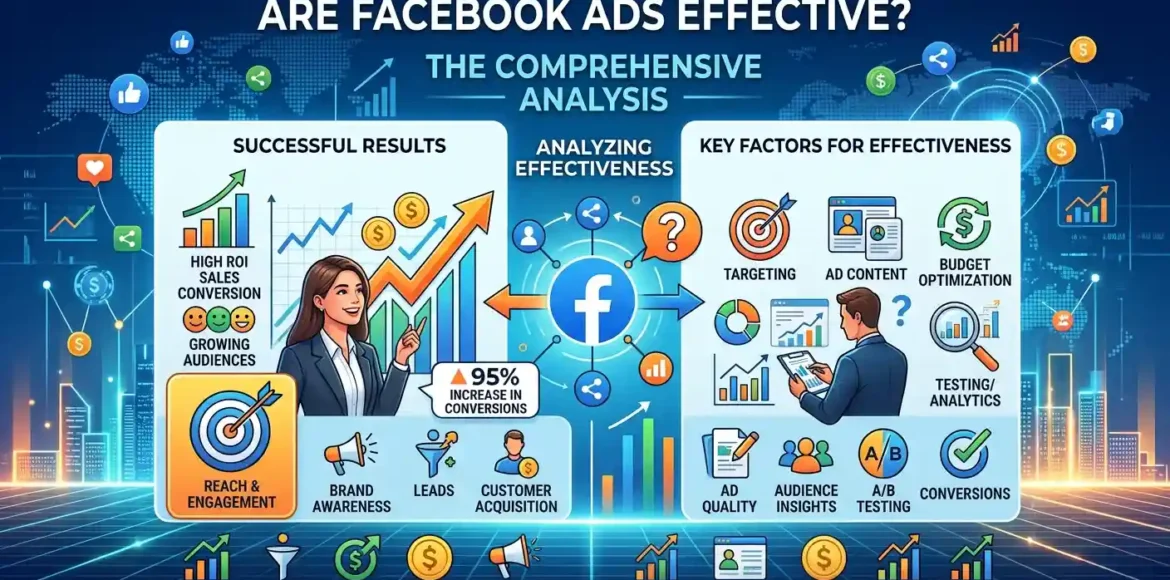
Are Facebook Ads effective for businesses that want more customers, leads, or sales? They can be, but there is no universal result that every business should expect.
Facebook advertising gives businesses a way to reach specific audiences with paid content across Meta’s advertising ecosystem. Depending on the campaign setup, businesses can focus on objectives such as awareness, traffic, leads, messages, or conversions.
The important question is not simply whether people will see or click your ad. The real question is what happens after that interaction.
For example, a local service company may consider a campaign successful when it generates qualified inquiries that turn into booked jobs. An online store may focus on purchases and revenue. A startup may initially care more about qualified leads, sign-ups, or building awareness in a specific market.
That difference is why the answer to “are Facebook ads worth it?” depends on the business model and how success is measured.
Quick Answer
Yes, Facebook Ads can be effective for small businesses, startups, and established companies, but results are not automatic. Effectiveness depends on factors such as your target audience, offer, ad creative, campaign objective, budget, landing page, follow-up process, and conversion tracking. The right way to judge Facebook advertising is by measuring meaningful business results, such as qualified leads, sales, customer acquisition cost, and revenue, rather than likes or impressions alone.
What Makes Facebook Ads Effective?

Facebook Ads work best when several parts of the marketing process support each other.
1. The Audience Matches the Offer
Even a well-designed advertisement can perform poorly when it reaches people who have little reason to buy.
Your audience should have a reasonable connection to what you sell. The message, creative, and offer should then speak to a problem, need, desire, or interest that matters to that audience.
For example, an ad promoting commercial accounting services should not use the same message as an ad selling inexpensive consumer products. The potential customer, buying process, and reason for taking action are different.
2. The Offer Gives People a Reason to Act
An advertisement can attract attention without creating enough motivation to take the next step.
A strong offer gives the user a clear reason to continue. Depending on the business, that could mean requesting a quote, booking an appointment, purchasing a product, downloading a resource, or contacting the company.
The offer also needs to be realistic. A dramatic discount may generate clicks, but if those clicks attract people who were never likely to become customers, the campaign may produce volume without useful business results.
3. The Creative Gets Attention Quickly
Facebook users scroll through large amounts of content. Your advertisement therefore has to communicate its main idea quickly.
Effective creative generally makes the following clear:
- What is being offered
- Who it is for
- Why it matters
- What action the user should take
Images, short videos, headlines, ad copy, and calls to action all contribute to the experience.
Testing different creative approaches can also help identify which message connects with your audience instead of assuming that the first version will be the best performer.
4. The Landing Experience Delivers on the Ad
Getting someone to click is only one part of the process.
If an advertisement promises a particular service, product, price, or benefit, the page the user reaches should make that information easy to find.
A slow, confusing, outdated, or poorly structured landing page can waste traffic generated by an otherwise effective campaign.
This is one reason Facebook advertising effectiveness should be evaluated across the entire customer journey, not just inside the advertising dashboard.
How Effective Is Facebook Advertising for Different Businesses?
Facebook Ads can serve different business models, but the desired outcome will vary.
Local Service Businesses
Local businesses can use Facebook Ads to introduce services to people in specific geographic areas and encourage actions such as calls, messages, form submissions, or appointments.
For these businesses, the number of leads is only part of the story.
Suppose a campaign generates 50 inquiries but only a few are qualified. Another campaign generates 20 inquiries and produces several actual customers. Looking only at lead volume could make the first campaign appear stronger.
The more useful question is:
How many qualified leads became paying customers, and what did it cost to acquire them?
E-Commerce Businesses
Online stores can track a more direct path from advertisement to product page to purchase.
Important measurements may include:
- Cost per purchase
- Conversion rate
- Average order value
- Revenue
- Return on ad spend
- Customer acquisition cost
- Repeat purchases
A campaign that generates sales is not automatically profitable. Product costs, shipping, payment fees, discounts, and other expenses also affect the final margin.
Startups
Startups may use Facebook Ads for several different purposes.
A new company may first want to determine whether a particular audience responds to its message. Another startup may use advertising to generate sign-ups or sales.
For early campaigns, the data itself can be useful. It can reveal which audience segments, offers, messages, or creative concepts deserve further testing.
However, spending money simply to collect clicks without a clear learning objective can quickly become expensive.
B2B Businesses
B2B advertising can involve a longer buying cycle.
Someone may see an advertisement today, download information later, speak with a sales representative weeks afterward, and become a customer much later.
Because of this, B2B companies should avoid judging every campaign solely by immediate purchases. Lead quality, sales-qualified opportunities, pipeline value, and eventual customer acquisition can provide a more useful picture.
When Are Facebook Ads Worth It?
Facebook Ads are more likely to make business sense when you understand your numbers before launching the campaign.
Start with a simple question:
How much can your business afford to spend to acquire one customer?
For example, imagine a service business earns $1,000 in revenue from a typical new customer. If its actual profit after fulfilling the job is $300, spending $250 to acquire that customer leaves only $50 before other overhead.
The advertising cost cannot be judged separately from the economics of the business.
This is why there is no single “good” cost per lead or cost per purchase that applies to every company.
A lead worth $100 to one business may be worth only $10 to another.
How to Measure Facebook Ad Effectiveness
Instead of focusing on one number, connect advertising metrics to the customer journey.
Reach and Impressions
These show how many people saw the advertisement and how frequently it was delivered.
They are useful for understanding exposure, but they do not prove that the campaign generated revenue.
Click-Through Rate
CTR helps show how often people clicked after seeing an ad.
A low CTR can indicate that the creative, message, audience, or offer needs attention.
But a high CTR does not guarantee sales.
Cost Per Lead
For lead-generation campaigns, cost per lead can help compare campaign performance.
However, inexpensive leads are not necessarily valuable leads.
You should also examine:
- Lead quality
- Contact rate
- Appointment rate
- Sales conversion rate
- Revenue generated
Cost Per Customer
This is often much closer to the actual business question.
If you spend $1,000 on advertising and acquire 10 customers, your advertising cost per customer is $100.
Whether $100 is acceptable depends on how much those customers are worth to the business.
Return on Ad Spend
ROAS compares advertising-attributed revenue with advertising spend.
For example, if a campaign produces $4,000 in tracked revenue from $1,000 in ad spend, the ROAS is 4:1.
However, ROAS should not be confused with profit. A business still has product, labor, fulfillment, software, and other expenses.
Why Facebook Ads Sometimes Do Not Work
When someone asks, “Why aren’t my Facebook Ads working?”, the platform itself is not always the problem.
Common issues include:
The Wrong Campaign Objective
If your goal is to generate leads but the campaign is optimized for a different type of action, the results may not match your business objective.
The campaign should be built around what you actually want the customer to do.
Weak Creative
An advertisement may fail to attract attention because the opening message is unclear, the visual is uninteresting, or the benefit is difficult to understand.
Testing multiple creative concepts can provide more useful information than repeatedly changing small settings without changing the actual message.
Poor Offer
Sometimes the advertisement is reaching the right audience, but the reason to act is weak.
Ask whether the customer understands what they get and why they should take action now.
Poor Follow-Up
A lead is not a customer.
If a business takes too long to respond, provides unclear information, or does not follow up consistently, advertising performance can look worse than it actually is.
The ad may be generating opportunities while the sales process is losing them afterward.
Weak Tracking
Without reliable conversion tracking, it becomes difficult to determine which campaigns are producing meaningful business outcomes.
A business may end up optimizing for clicks simply because clicks are easier to see than completed sales.
Facebook Ads vs. Organic Marketing
Paid and organic marketing serve different purposes.
Organic marketing can build visibility over time through useful content, search optimization, social posts, email marketing, and other non-paid channels.
Facebook Ads can put a message in front of selected audiences without waiting for organic distribution to build.
For many businesses, these approaches can complement each other.
For example, useful organic content can help establish trust, while paid campaigns can promote a specific offer or reach a new audience.
The right mix depends on the company’s goals, resources, audience, and sales cycle.
How to Improve Facebook Ad Results
If your campaigns are not producing the expected outcome, avoid changing everything at once.
Instead, work through the funnel.
Start With the Business Goal
Decide whether you want:
- Leads
- Sales
- Calls
- Messages
- Website actions
- Sign-ups
- Awareness
Your goal should determine what you measure.
Check the Offer
Make sure the offer is clear and relevant to the audience.
Review the Creative
Test different hooks, visuals, formats, headlines, and calls to action.
Examine the Landing Page
Make sure the page is relevant to the advertisement, easy to understand, mobile-friendly, and designed around the desired action.
Track What Happens After the Lead
For lead-generation campaigns, connect advertising results with your sales process whenever possible.
A dashboard showing 100 leads tells you much less than knowing how many of those leads became qualified opportunities and customers.
Give Tests Enough Time to Produce Useful Information
Constantly changing campaigns can make it difficult to understand what caused a result.
Testing should have a clear purpose. Change one meaningful variable when possible and compare the resulting business outcomes.
When Should a Business Consider Facebook Advertising Services?
Managing Facebook Ads involves more than creating an advertisement and selecting an audience.
Businesses may need help with campaign structure, audience research, creative testing, conversion tracking, landing pages, reporting, and ongoing optimization.
If your team does not have the time or experience to manage those areas, professional support may make the process easier to manage.
Businesses looking for a more structured approach can explore Facebook Advertising Services in New York through LocalPro1.
The important point is to choose a service based on your actual business goals rather than simply looking for someone to generate more clicks or impressions.
Key Takeaways
- Are Facebook Ads effective? They can be, but results depend on the complete marketing funnel.
- There is no universal cost per lead, click, or customer that works for every business.
- The right audience and a relevant offer are fundamental.
- Strong creativity can help attract attention and encourage action.
- A high click-through rate does not guarantee revenue.
- Lead quality matters more than simply generating a large number of leads.
- E-commerce businesses should consider revenue, acquisition cost, margins, and customer value.
- Local businesses should connect advertising leads with actual customers and booked jobs.
- Startups can use advertising both to acquire customers and learn which audiences and messages respond.
- Tracking should connect ad activity with meaningful business outcomes.
- Facebook Ads should be evaluated against your own economics rather than another company’s reported results.
Conclusion
Are Facebook Ads effective? Yes, they can help businesses generate awareness, leads, sales, and new customers when campaigns are built around the right audience, offer, creative, objective, and measurement system.
But Facebook Ads are not a shortcut to business growth. A campaign can generate thousands of impressions and still produce little value if the wrong people see the ad or the customer journey fails after the click.
The better approach is to look beyond surface-level metrics. Track what people do after seeing the advertisement, determine how many become qualified leads or customers, and compare the acquisition cost with the value those customers bring to your business.
For businesses that want help planning, managing, and improving paid social campaigns, LocalPro1 can provide Facebook advertising support focused on measurable marketing objectives rather than vanity metrics.
Frequently Asked Questions
Are Facebook Ads effective for small businesses?
Yes, Facebook Ads can be useful for small businesses when the audience, offer, campaign objective, and conversion process are aligned. Small businesses should focus on meaningful outcomes such as qualified leads, booked appointments, sales, and customer acquisition cost rather than engagement alone.
How effective is Facebook advertising for generating leads?
Facebook advertising can generate leads, but lead quality varies. A campaign should be evaluated based on what happens after the form submission or message. Qualified leads, appointments, customers, and revenue provide more useful information than lead volume alone.
Are Facebook Ads worth it for startups?
They can be, particularly when a startup has a clearly defined audience and a measurable goal. Startups should establish what they are trying to learn or achieve before spending heavily, then use campaign data to refine their audience, offer, and messaging.
How much should a business spend on Facebook Ads?
There is no universal budget that guarantees results. The appropriate amount depends on the business model, customer value, target market, campaign objective, competition, and testing requirements. A business should determine its acceptable customer acquisition cost before setting a larger advertising budget.
Why are my Facebook Ads getting clicks but no sales?
Clicks can happen without purchases when the offer, landing page, audience, pricing, checkout process, or sales funnel has a problem. High click volume alone does not prove that the campaign is reaching people who are ready to buy.
What is more important, clicks or conversions?
Conversions are generally more closely connected to a business outcome when the goal is to generate leads or sales. Clicks can help diagnose ad engagement, but a campaign should ultimately be evaluated against the action that creates value for the business.
